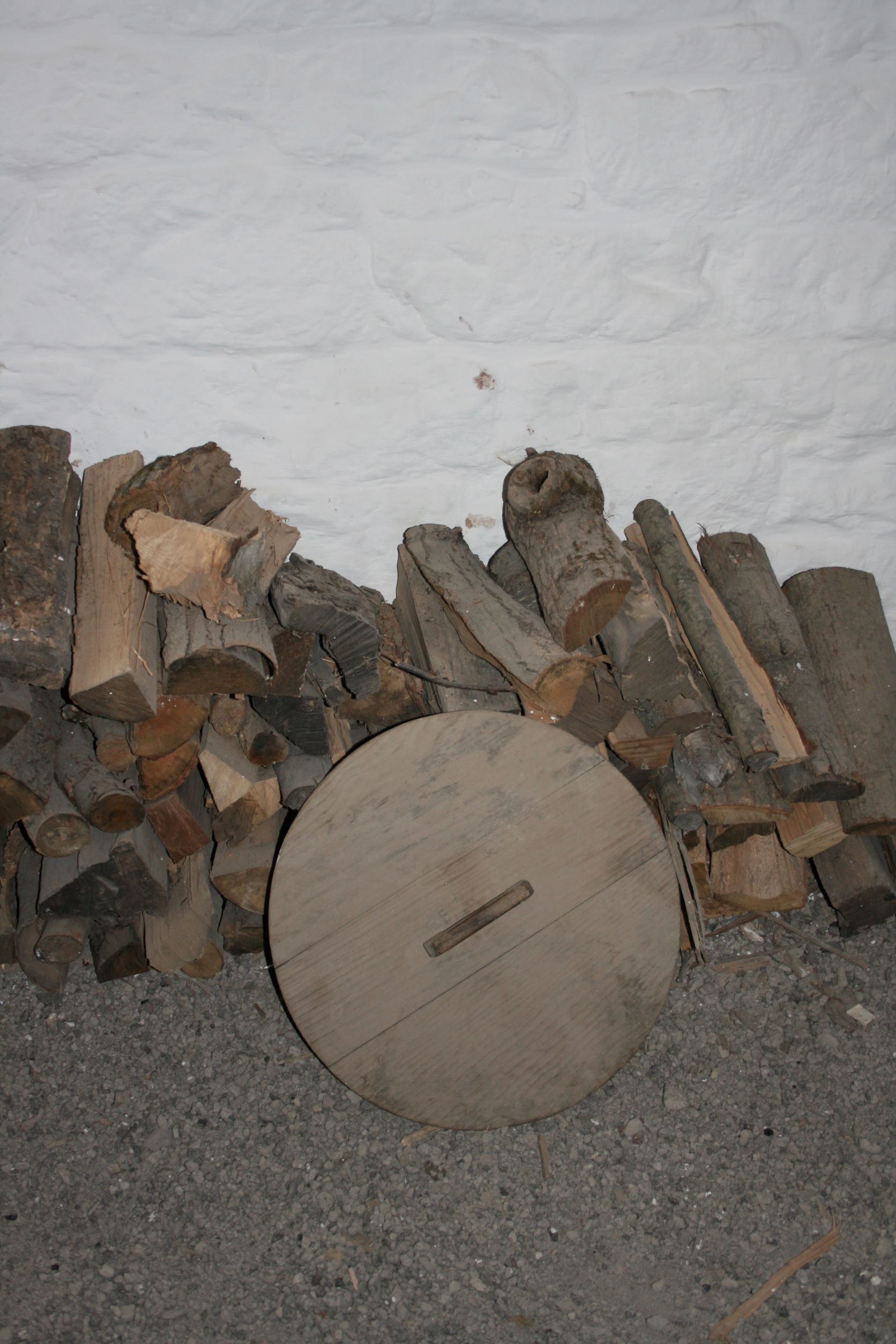
Welcome to a full week of photographs! Photo Spot Week will feature one photograph a day from February 21st through to February 27th. The third in this series is an image that basically is a still life rendered on film (albeit digital). I found this composition at Greenfield Village at The Henry Ford Museum in Dearborn, MI.
If memory serves, this was found in the basement of the original farm house owned by Mr. Firestone (yes, the tire guy). Henry Ford had purchased the structure and moved it to his living museum at the Village.
I like this shot because it is a study in texture and contrast. The colours don’t vary much but the block wall, the fire wood, the barrel lid, and the gravel floor, yield a concert of different things that all seem to harmonize.
The block wall has horizontal lines, the firewood is essentially vertical, the barrel lid has slanted lines, and the gravel floor is neutral. How these are layered from back to front in the image is interesting to me!
Welcome to a full week of photographs! Photo Spot Week will feature one photograph a day from February 21st through to February 27th. The second in this series is a candid image of Flik from Pixar’s second animated film, A Bug’s Life, released in 1998. I snapped it during an unguarded moment back in 2013.
Disney’s California Adventure is a Disney Theme Park in California (duh) that has a turbulent history. But love it or hate it, it does have some awesome Meet-and-Greets!
I’ve never liked the pictures I’ve taken with the characters at these Meet-and-Greets. I always end up just standing there like a statue with no real character of my own! So my mission while waiting in line is to catch the character in a candid moment without a guest in the shot. At least that way I can come away with something worth while!
I like how this turned out. Flik is looking off-camera and is responding to something that has been done or to something that has been said to him. The image leaves you wondering just what that could have been. And that, I believe, is what adds interest to an otherwise straight forward shot.
Welcome to a full week of photographs! Photo Spot Week will feature one photograph a day from February 21st through to February 27th. The first in this series is an image from the Dinosaurs Alive! exhibit that was presented at Canada’s Wonderland back in 2015.
“Is it real, or is it Memorex?” Perhaps you remember that slogan from the successful ad campaign for cassette tapes from the early 1980s. The brand of audio recording tapes (sorry, no VHS tapes yet) offered such an authentic capture, representation, and playback experience that the listener would not be able to tell if they were listening to the actual conversation or performance or if it was simply being played back for them on audio tape. Only a Memorex tape, of course!
Looking at the picture below, would you say it’s a real dinosaur?
Obviously it isn’t real! Dinosaurs have been extinct for a few seasons now. I like how the silhouette still has some light areas, just enough to make you wonder, but enough shadow to make it impossible to tell. Unless you’re an adult and know history and basic paleontology. But hey, maybe you could use this image to fool your kids!
Dinosaurs Alive! was an amazing semi-animatronic presentation of very detailed dinosaur figures.
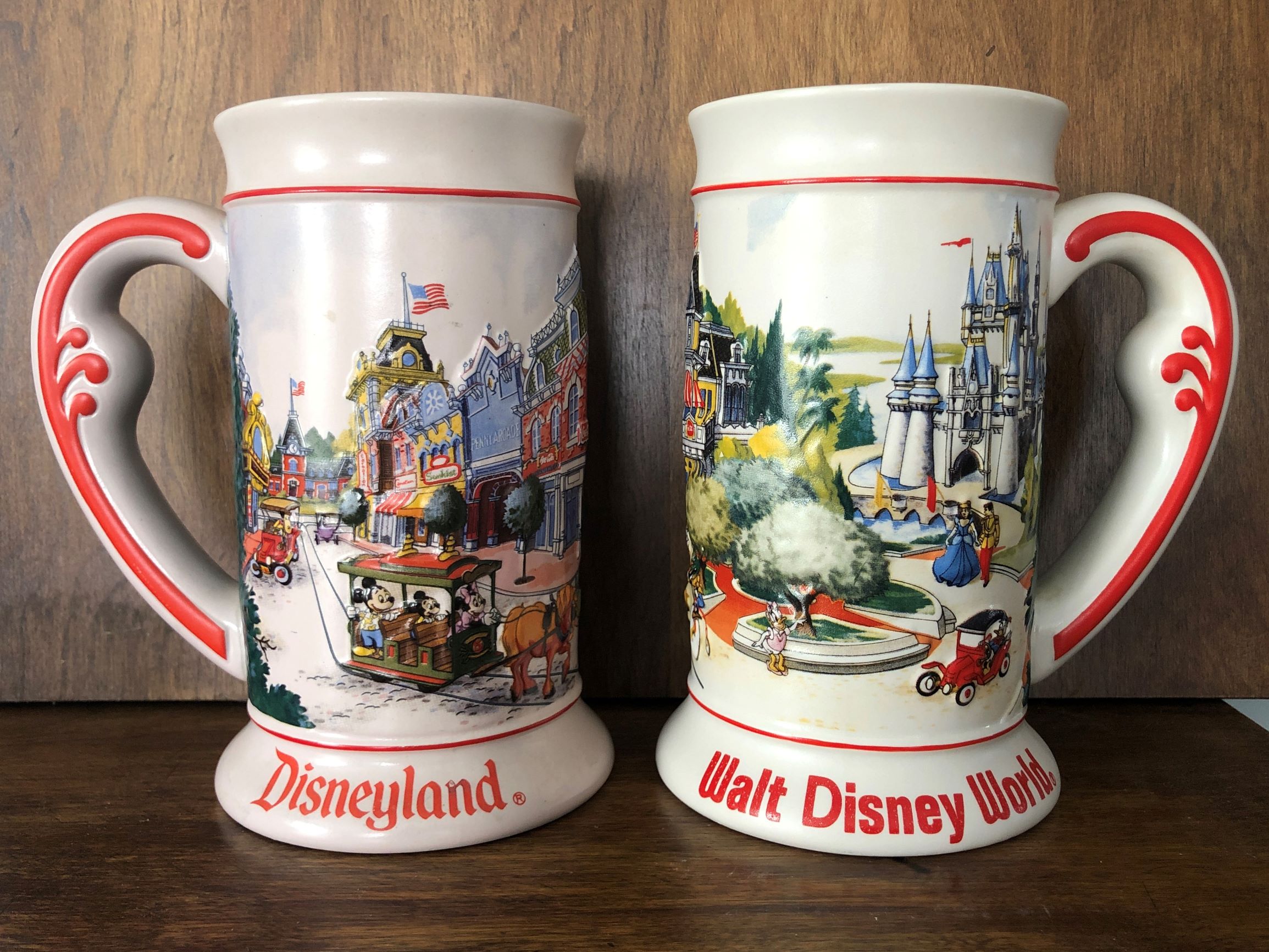
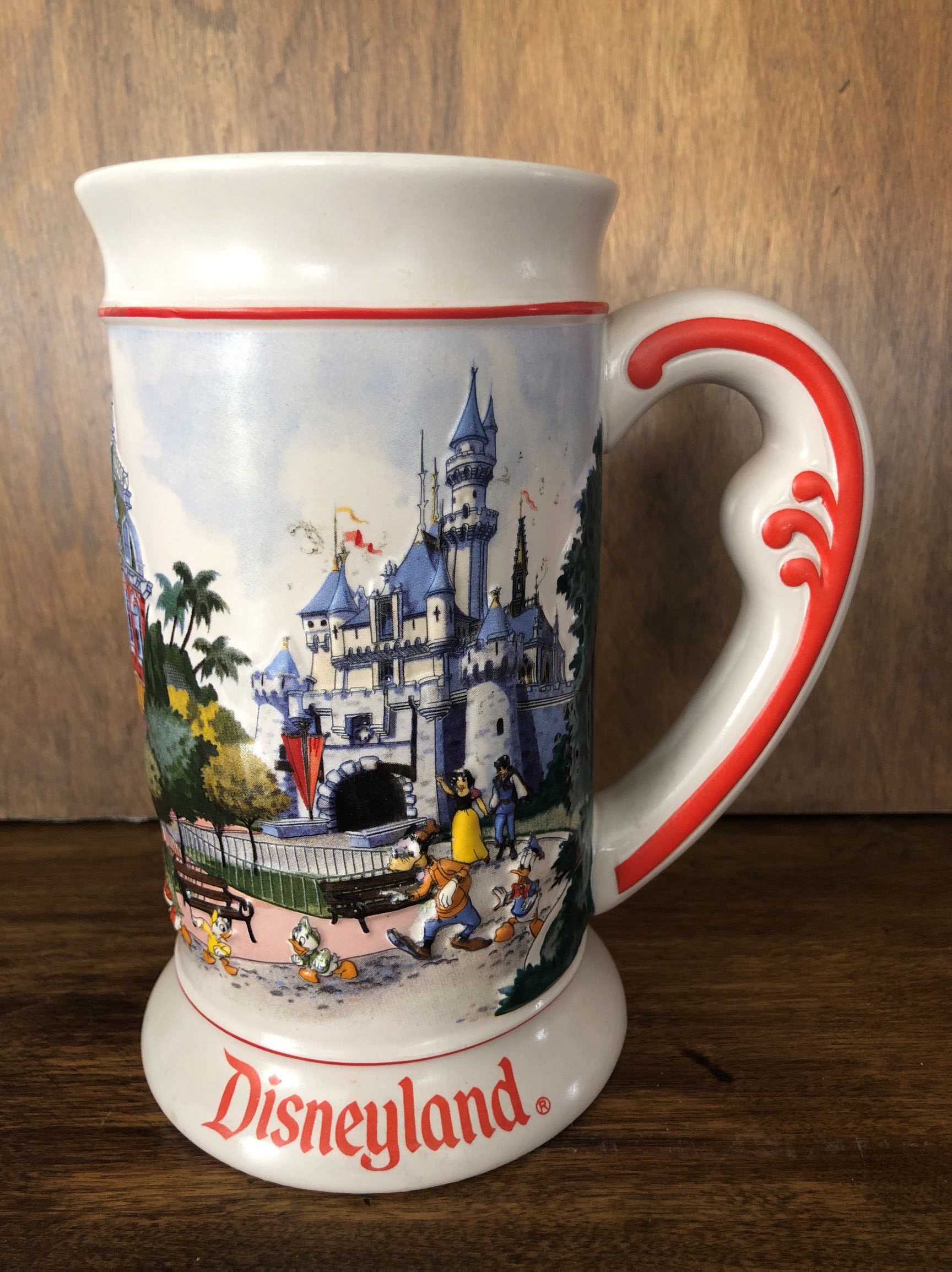
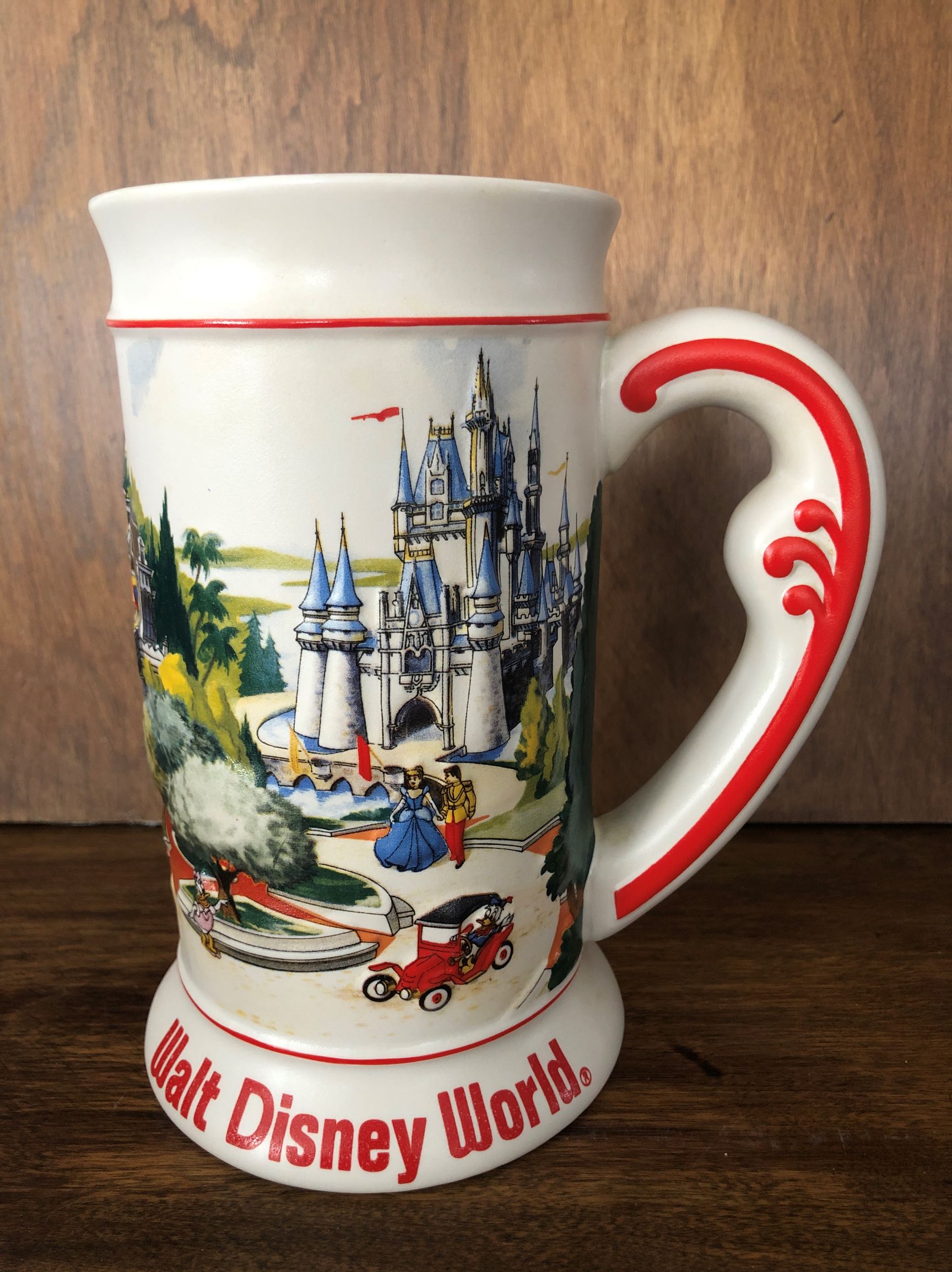
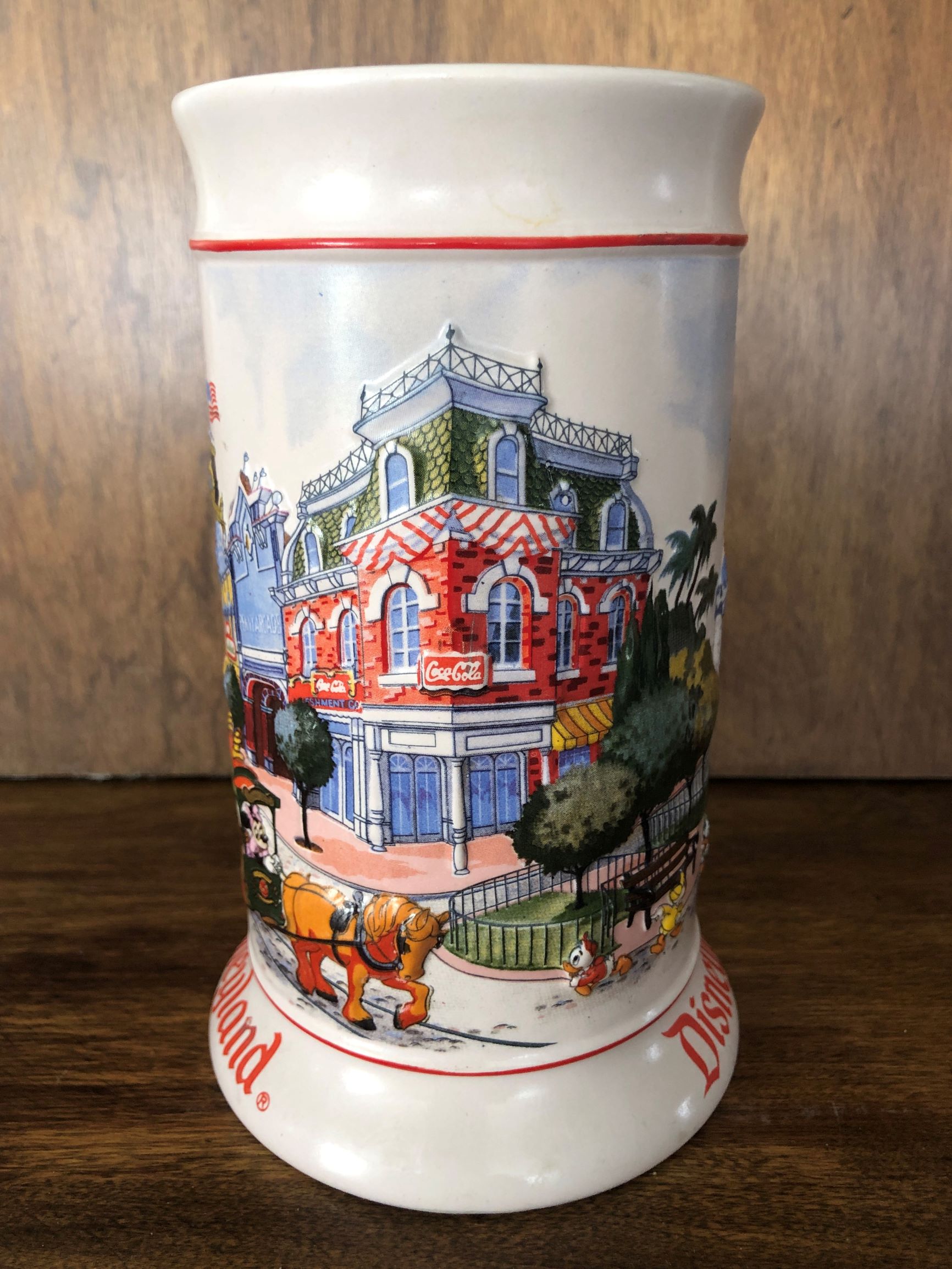
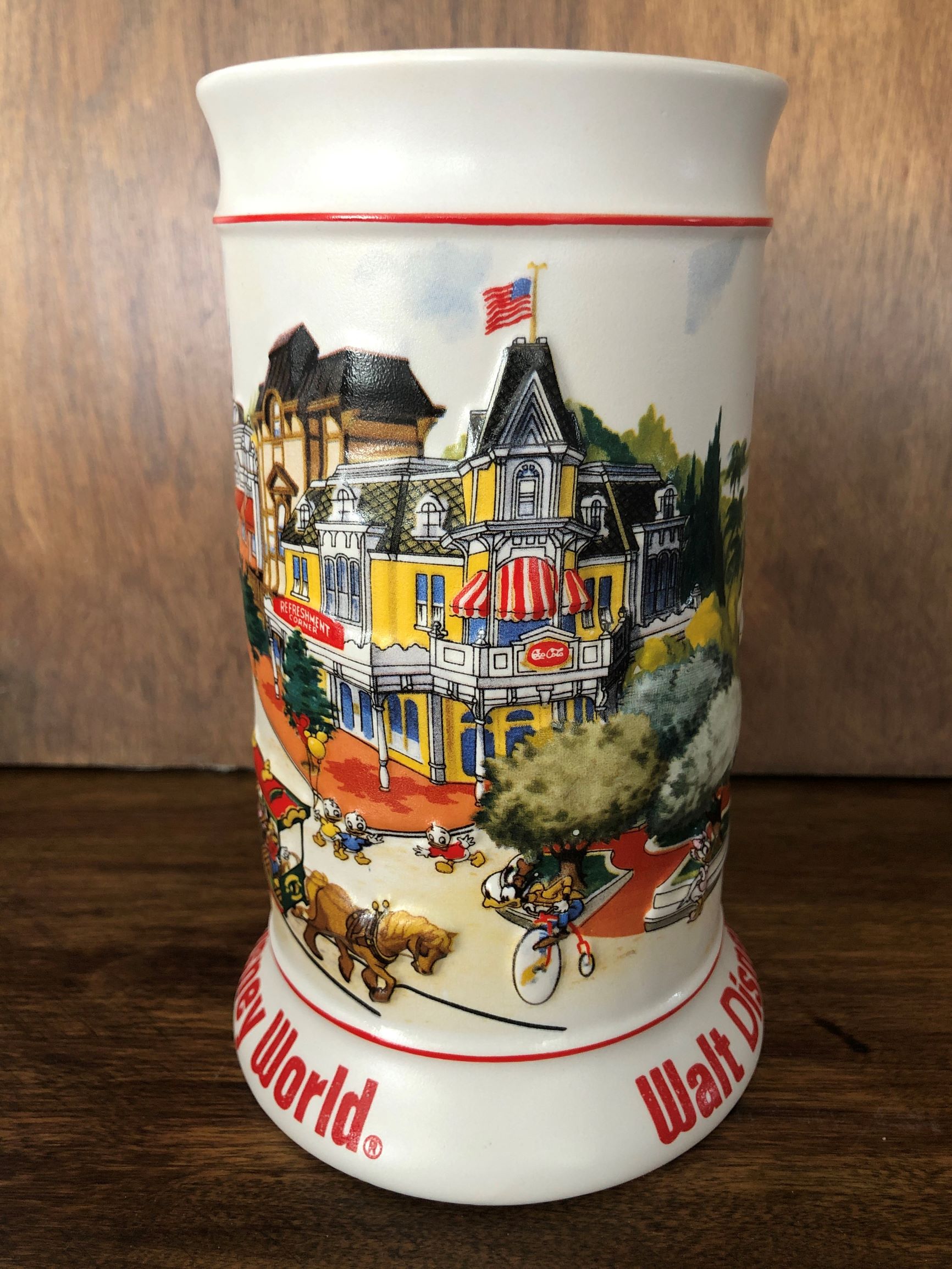
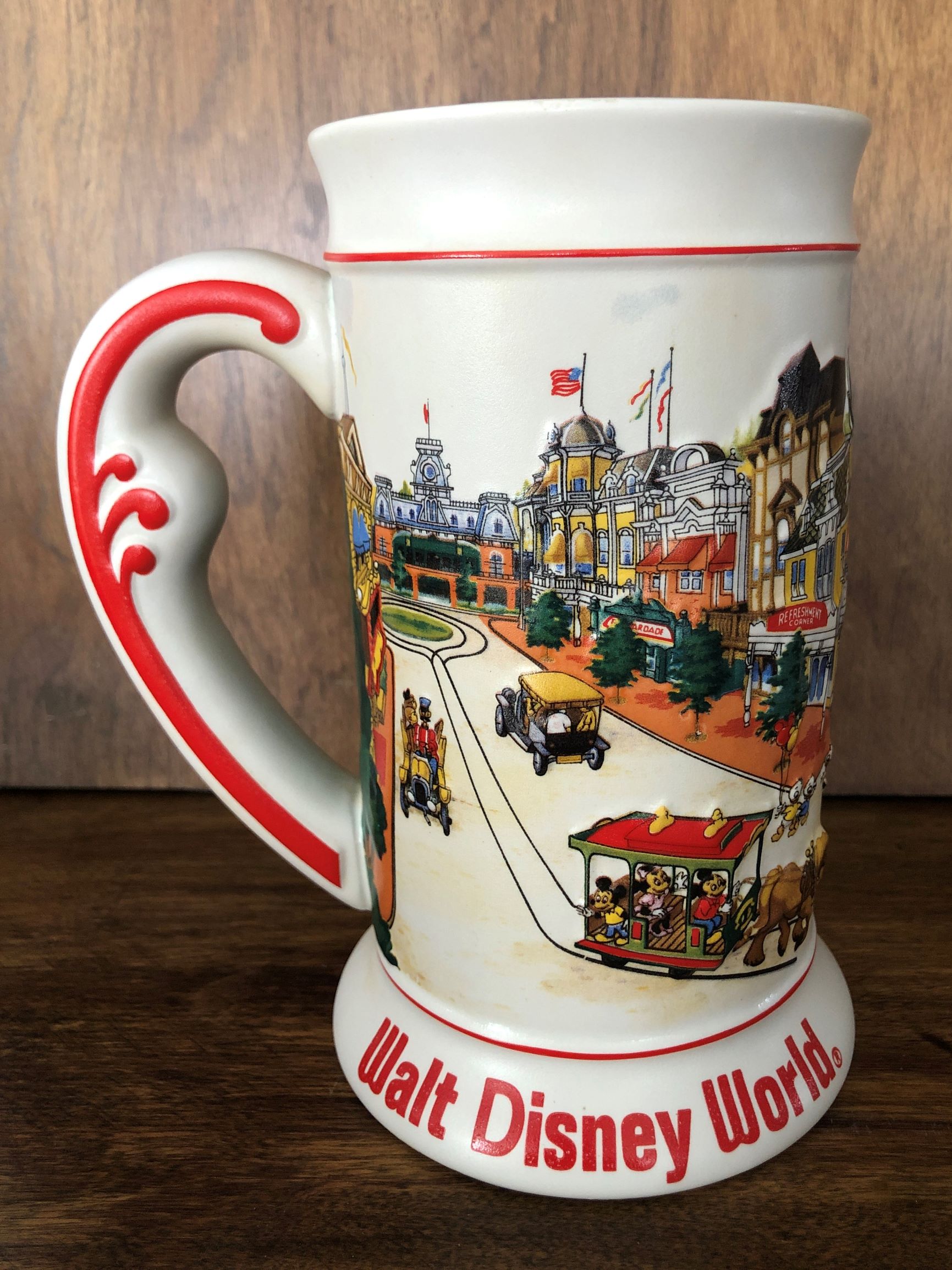
I have just completed a set of two decorative Disney steins that feature both the Disneyland and Walt Disney World Theme Parks. They are made by Ceramarte in Brazil. They have that wonderful chunky charm of vintage ceramics and likely date from the 1990s.
Side by Side Comparison
I’ve owned the Disneyland version for years and wasn’t really aware that a Walt Disney World version existed, although I should have been, as it is quite common for the North American Parks to release companion merchandise like this.
I had a vague idea that I had seen one of these before or already owned it when I enquired after the WDW version on a local selling site, but as the price was only $10.00, I figured I had nothing to lose by ‘rescuing’ another one from obscurity. Imagine my delight when I discovered that I did indeed already own one, but that it was the companion! My set of two was complete.
As you compare the Disneyland version with the Walt Disney World version (both above), you’ll see many similarities. Such as the setting of Main Street USA for both mugs. Both feature the Main Street Vehicles and a cast of the main Disney characters, such as Mickey, Donald, and Goofy. Each has the iconic Castle for the Park in question with the appropriate (?) Princess with her Prince walking just in front of it.
But there are differences as well. Let’s have a look at those. We will start from one side on each mug and compare the images we encounter side by side. DL will be on the left, and WDW on the right:
Horace Horsecollar is driving the electric Main Street Car for DL but a rather posh couple are driving a slightly different car in the WDW version.
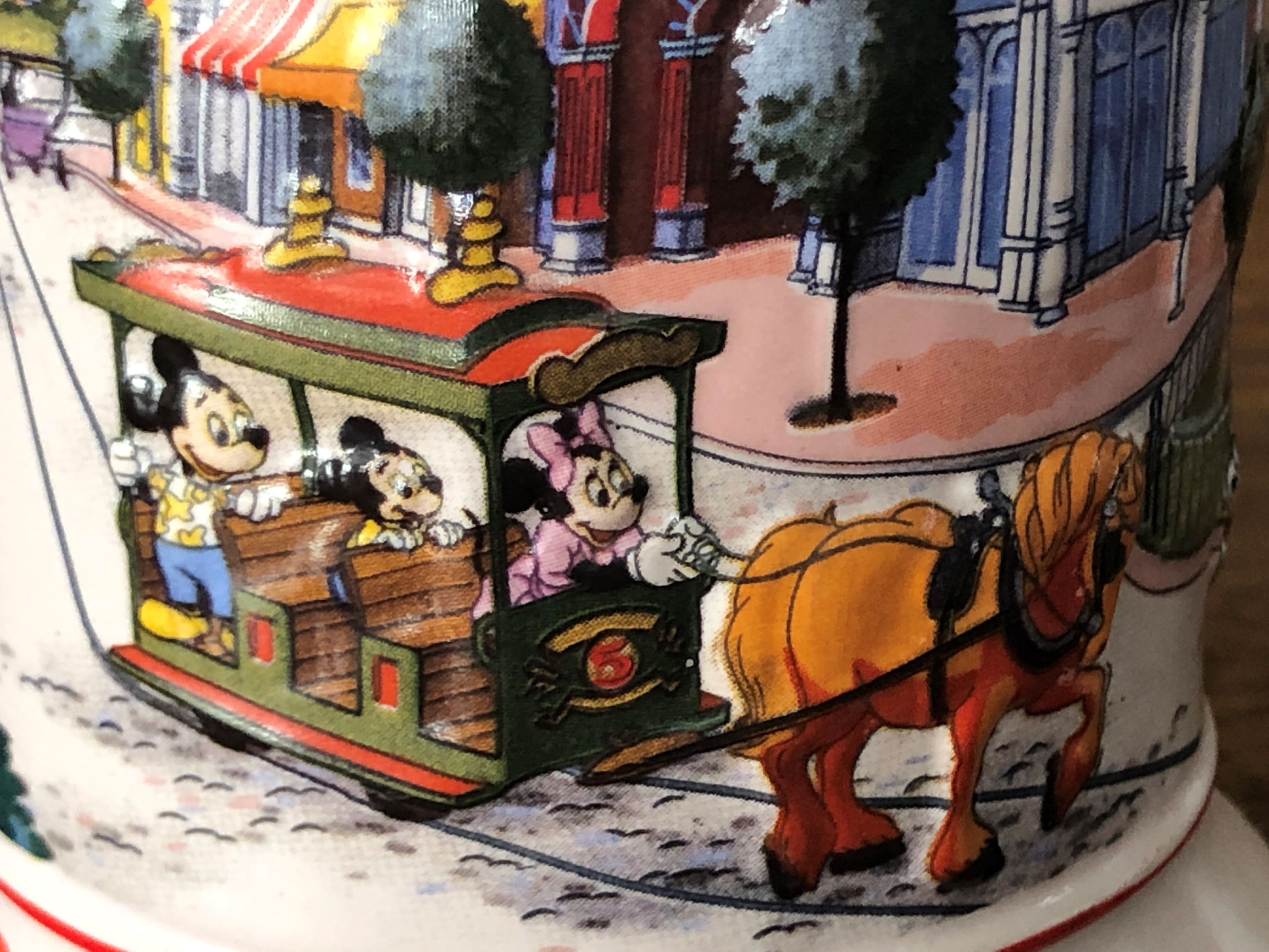
In DL, Minnie Mouse is driving the trolley with Mickey and one of his nephews in the back, whereas in WDW, Mickey Mouse drives the trolley with Minnie in the back with one of his nephews. Huey, Dewey, and Louie appear in the background in WDW.
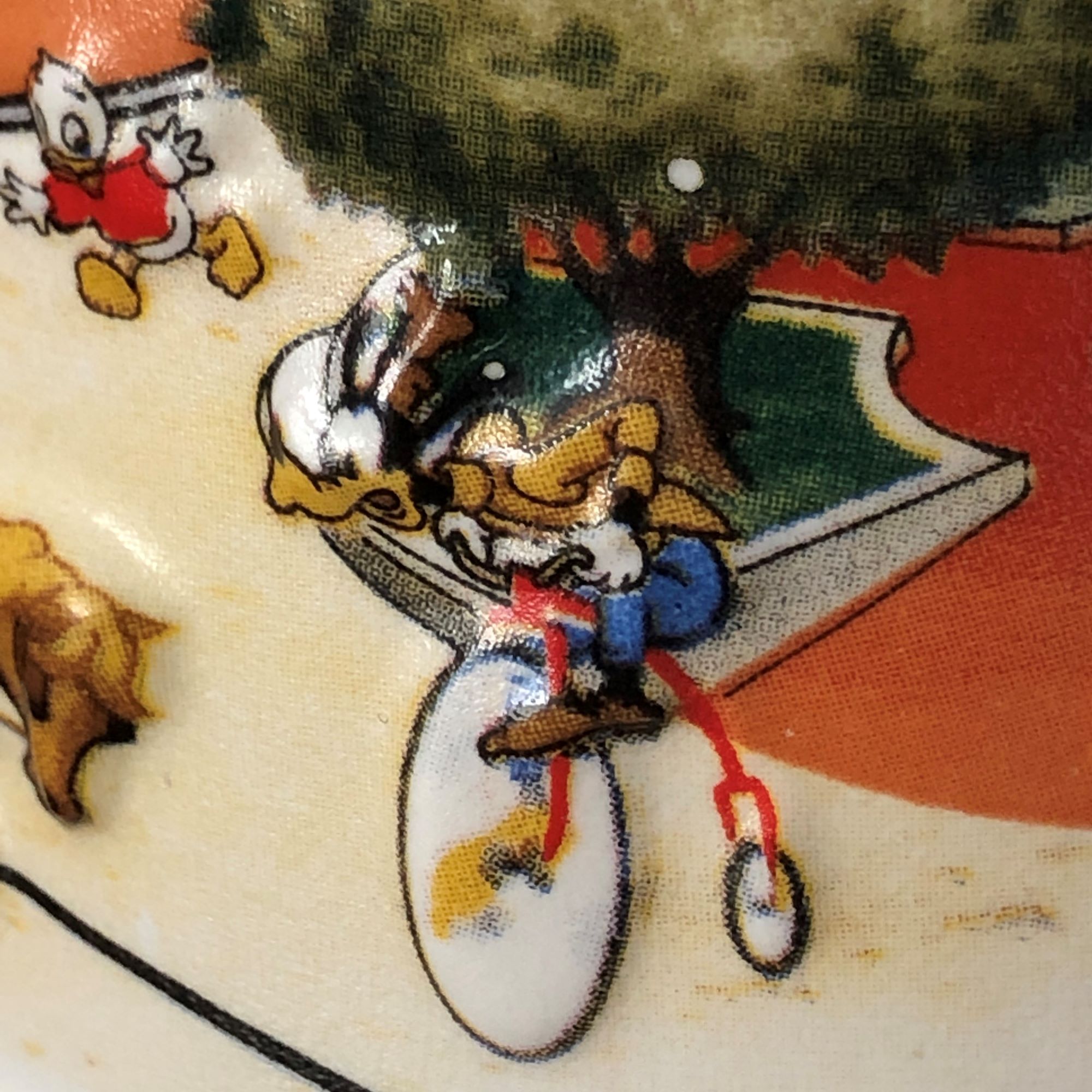
But in DL, Donald Duck’s nephews appear in a scene all their own right where Goofy is about to crash a Penny-farthing bicycle in the same place on the WDW mug.
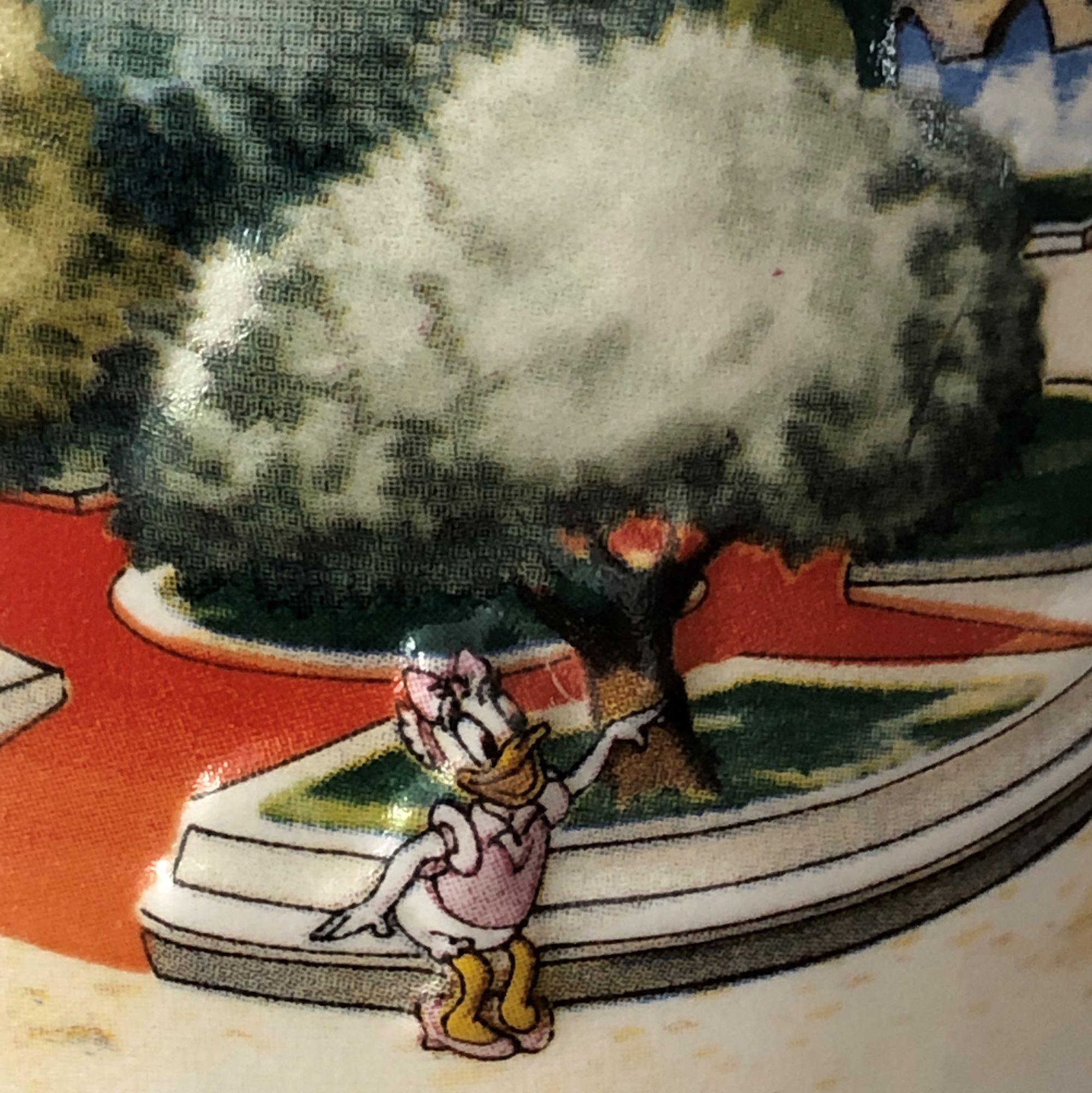
Two extra scenes are included on the DL mug. Daisy Duck is seen waving to someone and that someone turns out to be Donald Duck who is driving the same electric Main Street Car that Horace Horsecollar is driving just across the way. Now that’s a good trick!
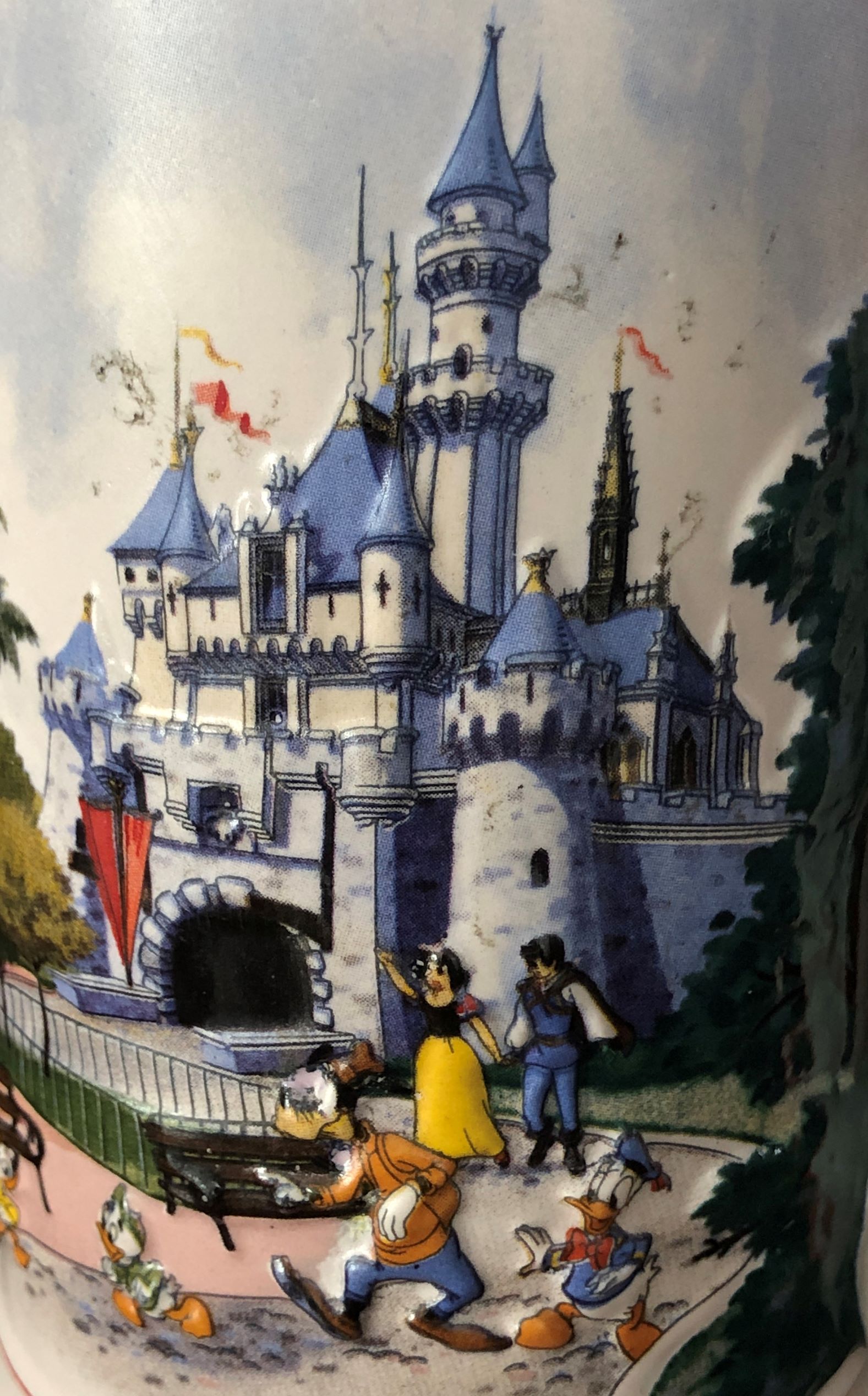
The comparisons end with the Castles. On the DL mug, Louie, Goofy, and Donald are seen walking in front of Snow White and Prince Charming. Of course, it should be Aurora, as it is Sleeping Beauty Castle that we find at Disneyland. But at Walt Disney World, we find Cinderella Castle with the appropriate Princess walking in front, with her Prince, of course!
I love finding these companion pieces with their similarities and differences!
Ceramarte no longer appears to be in business but leaves behind a strong legacy of well made collectibles that will adorn the shelves of collectors for years to come!
FUN FACTS: Why are Donald’s nephews wearing different colours? More than just to tell them apart, there is a reason behind the colour choices. Note that the brightest hue of the three is red (Huey), the color of water, dew, is blue (Dewey), and that leaves Louie, and leaves are green (Louie).
Mary Poppins was released on August 27, 1964, to critical acclaim and commercial success. It became the highest-grossing film of 1964 and, at the time of its release, was Disney’s highest-grossing film ever. It received a total of 13 Academy Awards nominations, winning five. Among the winners was Best Original Music Score and Best Original Song for “Chim Chim Cher-ee”. So no wonder there are so many versions of the soundtrack out there, like the selection of Mary Poppins LP records in this post.
Mary Poppins is considered Walt Disney’s crowning live-action achievement. And I’d like to say that it is largely due to the wonderful job Richard and Robert Sherman did on the music.
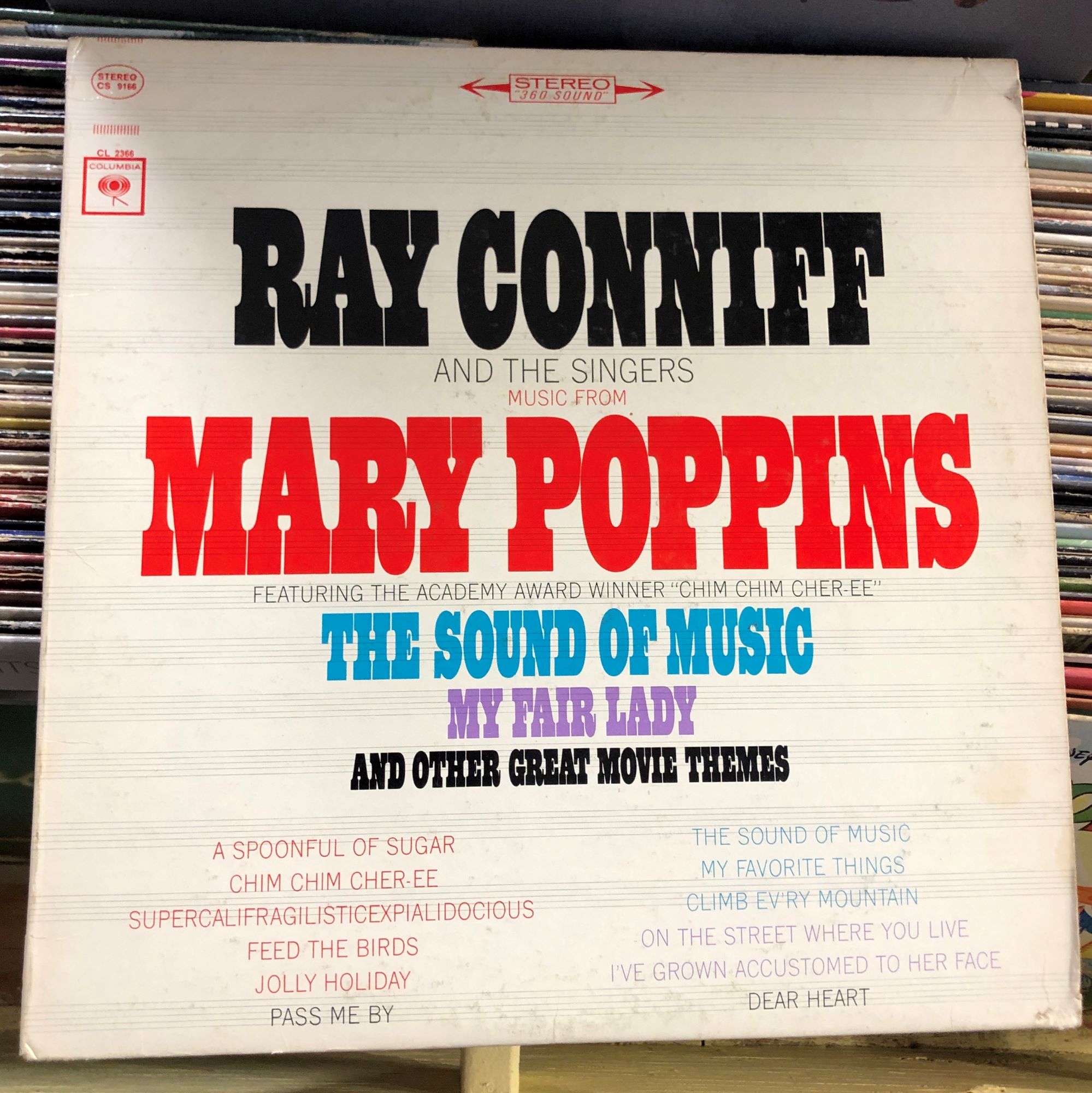
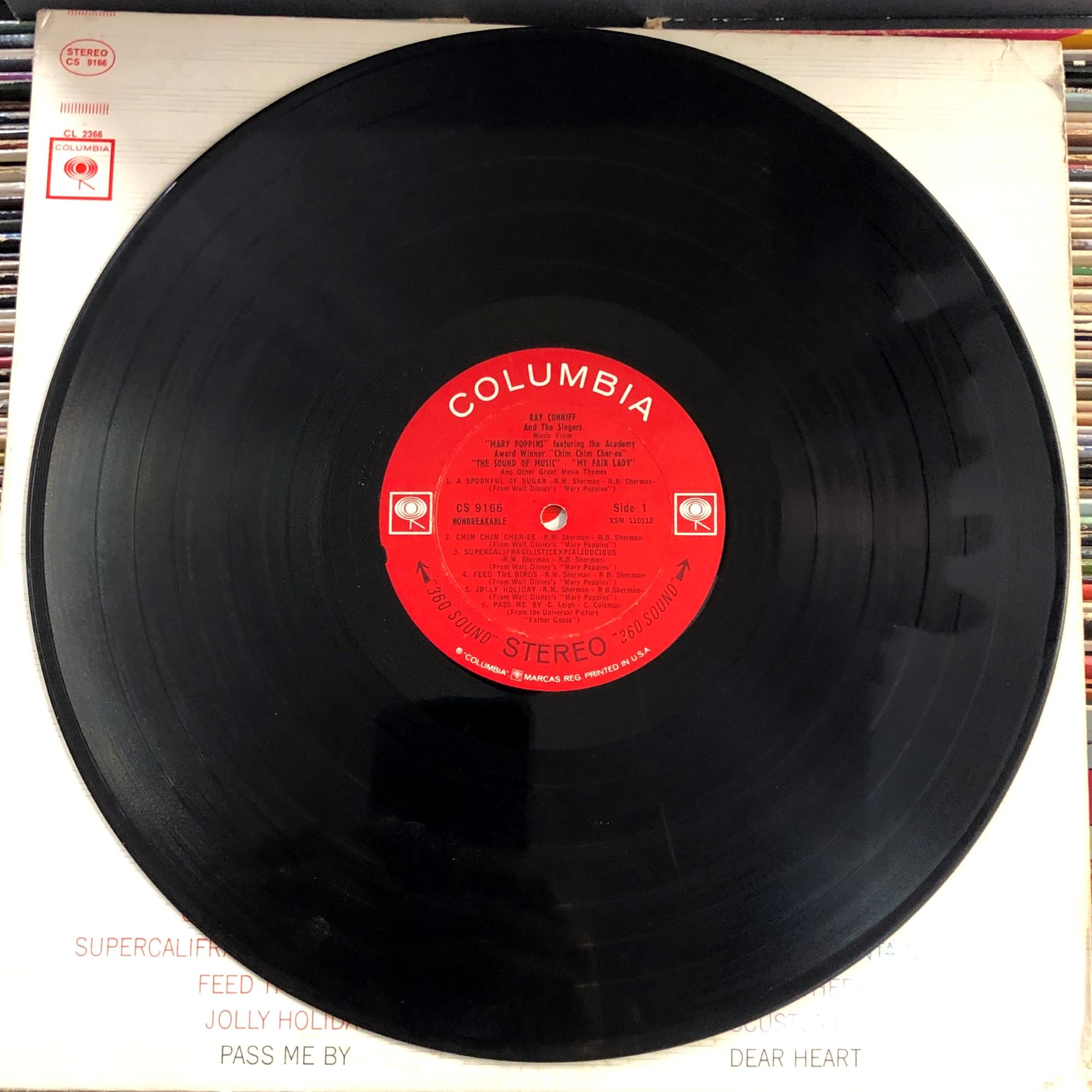
I’ve already covered an LP version of this movie’s soundtrack as interpreted by Lawrence Welk, so it only feels right that we give Ray Conniff and The Singers their place at the mic:
Joseph Raymond Conniff (November 6, 1916 – October 12, 2002) was an American bandleader and arranger best known for his Ray Conniff Singers during the 1960s. So it’s appropriate that he would be asked to give his take on the classic songs from the movie in 1965. He was the hottest thing since sliced bread at the time!
This record also included songs from The Sound of Music, another Julie Andrews vehicle, My Fair Lady, a movie that Julie Andrews should have been in as she was the one to make the role famous on Broadway, and other movie themes. So it appears that this was an anthology effort. It’s interesting though how much of it centers on Andrews body of work.
I didn’t buy it due to the poor condition of the vinyl record itself.
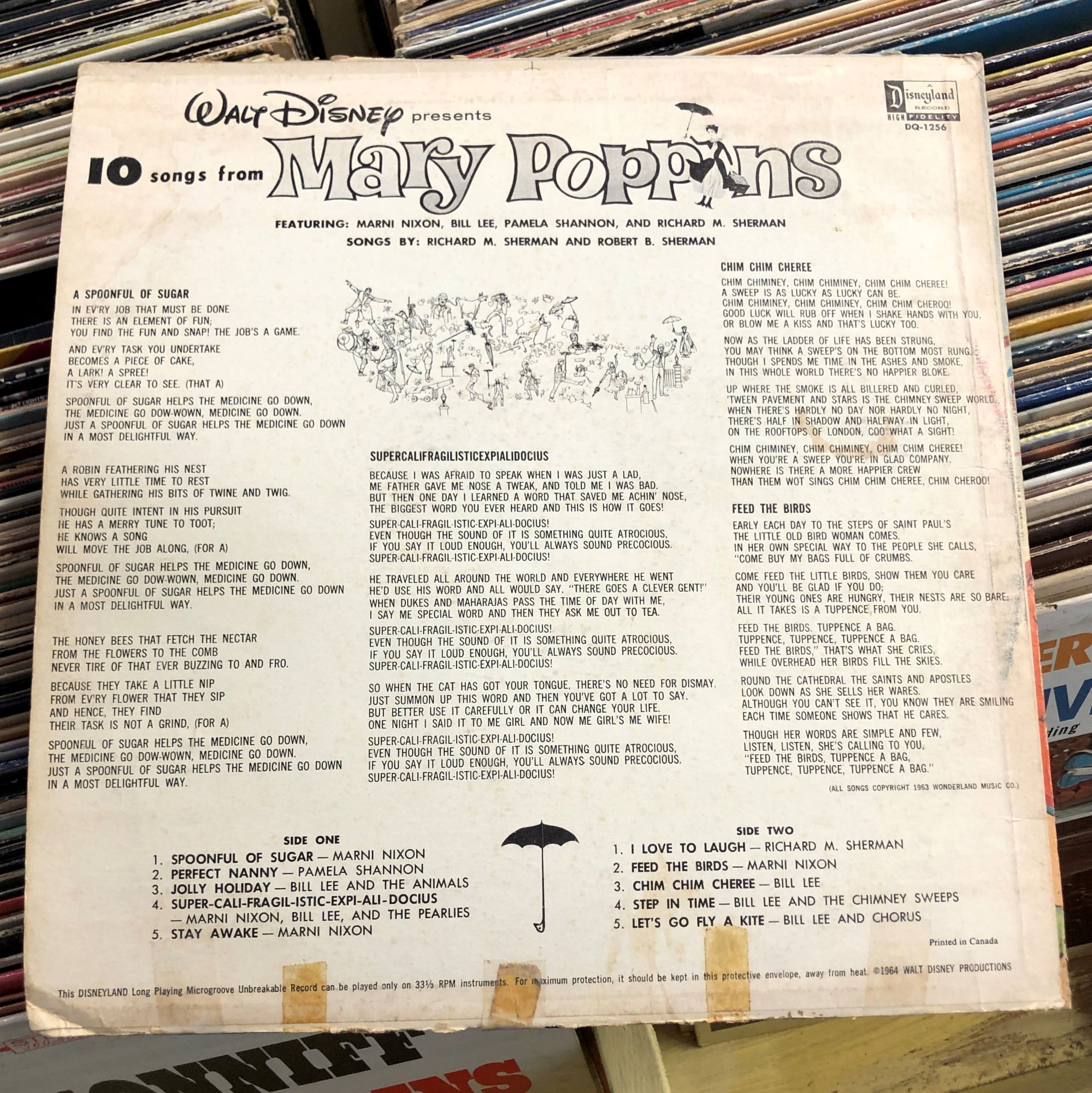
The next LP is from 1964, the same year the Disney movie came out. It was in even worse shape than the LP above, both the vinyl and the sleeve. Pity. I really liked the artwork:
This appears to be primarily demo tracks, and not the actual music from the movie, as sung by Julie Andrews, Dick Van Dyke, and others of the original cast. Instead, Marni Nixon, Bill Lee, and Richard Sherman provide all of the vocals. This would be awesome as it is a chance to hear other versions of familiar hits!
The good thing about these old vinyl records is that the market for them is limited. So the prices are reasonable. These were 3 for $10.00 as you picked through a bargain bin. Mint condition copies can fetch between $10.00 and $25.00 CAN.
Vinyl is on the way back in among young listeners today. For me, it never left!
Mary Poppins was released on August 27, 1964, to critical acclaim and commercial success. It became the highest-grossing film of 1964 and, at the time of its release, was Disney’s highest-grossing film ever. It received a total of 13 Academy Awards nominations, winning five. Among the winners was Best Original Music Score and Best Original Song for “Chim Chim Cher-ee”. So no wonder there are so many versions of the soundtrack out there, like the selection of Mary Poppins LP records in this post.
Mary Poppins is considered Walt Disney’s crowning live-action achievement. And I’d like to say that it is largely due to the wonderful job Richard and Robert Sherman did on the music.
I’ve already covered an LP version of this movie’s soundtrack as interpreted by Lawrence Welk, so it only feels right that we give Ray Conniff and The Singers their place at the mic:
Joseph Raymond Conniff (November 6, 1916 – October 12, 2002) was an American bandleader and arranger best known for his Ray Conniff Singers during the 1960s. So it’s appropriate that he would be asked to give his take on the classic songs from the movie in 1965. He was the hottest thing since sliced bread at the time!
This record also included songs from The Sound of Music, another Julie Andrews vehicle, My Fair Lady, a movie that Julie Andrews should have been in as she was the one to make the role famous on Broadway, and other movie themes. So it appears that this was an anthology effort. It’s interesting though how much of it centers on Andrews body of work.
I didn’t buy it due to the poor condition of the vinyl record itself.
The next LP is from 1964, the same year the Disney movie came out. It was in even worse shape than the LP above, both the vinyl and the sleeve. Pity. I really liked the artwork:
This appears to be primarily demo tracks, and not the actual music from the movie, as sung by Julie Andrews, Dick Van Dyke, and others of the original cast. Instead, Marni Nixon, Bill Lee, and Richard Sherman provide all of the vocals. This would be awesome as it is a chance to hear other versions of familiar hits!
The good thing about these old vinyl records is that the market for them is limited. So the prices are reasonable. These were 3 for $10.00 as you picked through a bargain bin. Mint condition copies can fetch between $10.00 and $25.00 CAN.
Vinyl is on the way back in among young listeners today. For me, it never left!
I have many passions. Obviously I enjoy Disney and all of its characters, movies, and Theme Parks. But I’m also an avid reader, so many of my posts will focus on vintage hardcover publications. But artwork and photography have always been a big part of my life, perhaps more than any of these other things!
So when I travel, such as to places like the Weeki Watchee Springs State Park in Florida, I always find something to photograph.
c. 2009
I try to choose subjects that aren’t just made-to-order beauty shots. Point-and-click compositions are nice and a part of anyone’s vacation journal, but more should be done to find interesting and creative shots as well.
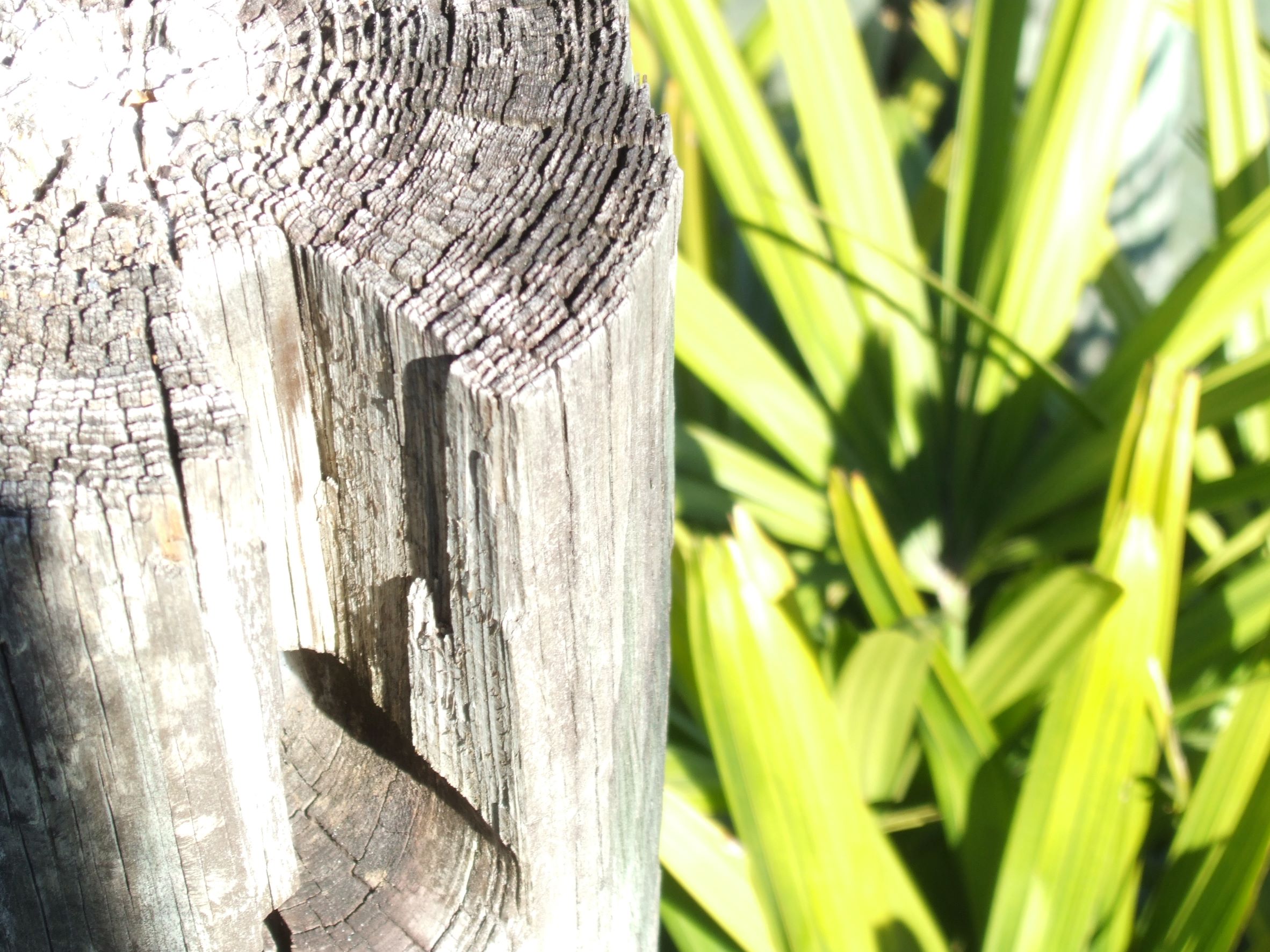
Weeki WacheeSprings is a quintessential Old Florida site and is home to the deepest freshwater cave system in the country and abundant vegetation and protected wildlife. It is the vegetation that caught my eye in the shot above.
I love the competition from left to right: bland to vibrant colour / focused to unfocused / and the variety of textures. It doesn’t really have a central subject or theme, but stands alone as a study in contrasts.
Monsters Inc. was released by Pixar in 2001 to rave reviews. The carefully crafted world of our monsters, both under the bed and in the closet, resonated with young and old alike! And perhaps one of the most unsung heroes of the production was George Sanderson who’s talking figure we are featuring in this post.
Our boy George is an orange monster that is prone to run afoul of the CDA’s “Code 2319” (contact with a human child) several times, forcing the CDA to shave and scrub him down to remove any traces of human contact. Embarrassing? You bet!
But at least he got his own Action Figure:
“George Sanderson here.”
After the Child Detection Agency (CDA) finishes shaving and scrubbing the hapless monster, he is put into his very own Cone of Shame:
Clearly, he did not take it very well.
“No! Not my fur!”
This collectible figure is made of solid plastic and has movable arms. His head can be pushed forward and down to activate three phrases. They are:
“Ooh-oh, not another 2319!”
At first I thought the toy could have had a few more sayings, but then I realized that George was a minor character in the film with just these few lines of note. He is not interactive with any other Monsters Inc. toys so three phrases seems enough to complete the presentation.
Battery Compartment & Type
You will need three 1.5 volt A76/LR44 button batteries. The designation with Energizer is 357/303 in case you need to pick up some. They are sold individually for about five dollars a piece. Fortunately, many other similar toys put out by Disney/Pixar use the same batteries, so you can swap them around.
George Sanderson is voiced by Samuel Lord Black in the films.
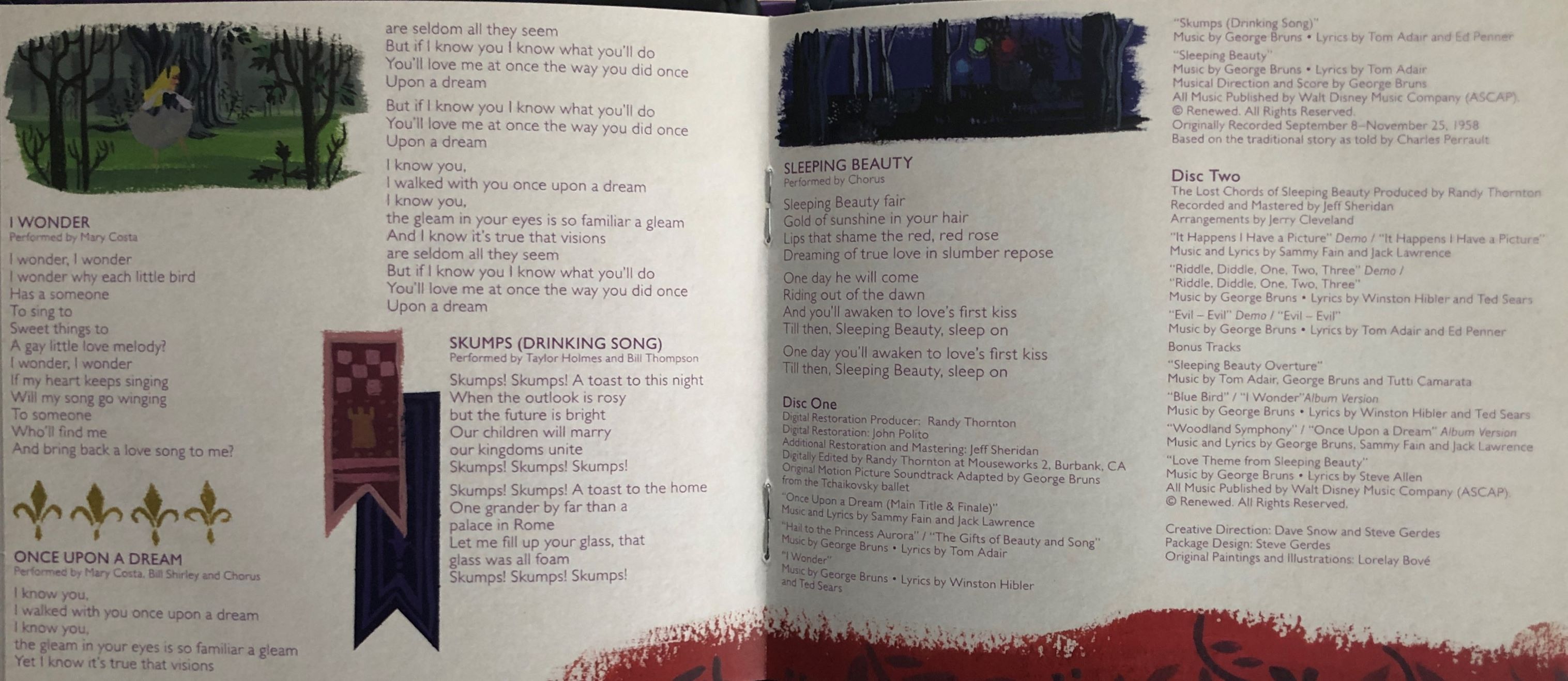
The Walt Disney version of Sleeping Beauty was released in 1959. The Legacy Collection Sleeping Beauty CD Set was the third to be released in the series and was available on October 7, 2014, to coincide with the 55th anniversary of Sleeping Beauty. The first disc contains the film’s complete original soundtrack and the second disc contains three demo recordings, three “Lost Chords” recordings, and four bonus tracks.
This is a 2-disc set, unlike the LC Mary Poppins CD Set that we just reviewed, that had 3 discs.
Again, I can’t say enough about the beautiful artwork of this series! The cover art and interior concept art is spectacular and almost reason enough to buy them even if there weren’t music. But thankfully there is.
Opening ImageClosing Image
As usual, we start with some pages of Production Notes, giving insider notes on the production of the movie:
Next we get several more pages of Lost Chords which contain insights into the music specifically, but not exclusively.
One of the songs that wasn’t used would have highlighted the one-upmanship between the two King fathers as they brag about their offspring. Have a listen:
It Happens I Have a Picture– Randy Crenshaw & Dennis Kyle
I liked this one not just because it’s fun, but also because Hans Conried did the vocals for the original demo track. Who knew that ol’ Captain Hook liked fairy tales?
The Concept Art pages are always a treat with this series! Just feast your eyes on the following images and see if you don’t agree:
As you can see by the image below, these CD sets are packed with musical content, far more than other soundtrack releases.
We conclude with a look at Aurora napping as she awaits her Princely kiss:
Back Cover
Should we be disturbed that the iconic kiss that awakens her was not consensual? Considering Aurora was under a curse and could only wake up by being kissed, and it was supervised by the Three Good Fairies, I think it was a better solution than just leaving her there to rot!
I hope you’ve enjoyed checking out these CD sets with me. I have five in total to date, so be sure to follow the links backwards from here to enjoy them all!
FUN FACTS: Mary Costa, the voice of Sleeping Beauty, had a strong Southern accent. She had to tone it down for the movie as well as temper her operatic diva styling while singing. After all, Aurora was only supposed to be 16-years old and needed to sound youthful.
Checker Motors Corporation was a vehicle manufacturer and main subcontractor for the manufacturing of taxicabs used by the famous Checker Taxis, as well as other companies, in both New York and other major US cities. Checker made the iconic American taxi cab, valued by taxicab companies for its durability in heavy use. So they were everywhere back in the day! They made a variety of models but settled into the one you will probably recognize:
After a time, the Checker company couldn’t afford to retool to bring out new models and so produced the model above almost to the last day of production, long after it had gone out of style, and been left behind by more modern vehicles available from the Big Three. But no other taxi cab is as loved and remembered as this one! And so it is the basis for the exclusive “Hey, Taxi!” New York Disney Store Vinylmation figure I am sharing in this post:
“Hey, Taxi!”
Note the New York skyline on Mickey’s head along with the iconic TAXI sign with lights on the ‘roof ‘. Also, we see the windshield on his tummy and the grill with headlights on his feet.
We visited New York City in 2012 and made it a point to visit the Disney Store in Times Square:
“Come on in, Pal!”
It was two stories tall and packed full of great merchandise. But the best piece was this exclusive New York taxi Vinylmation! You can only buy it there. And hey, it came with a collectible tin:
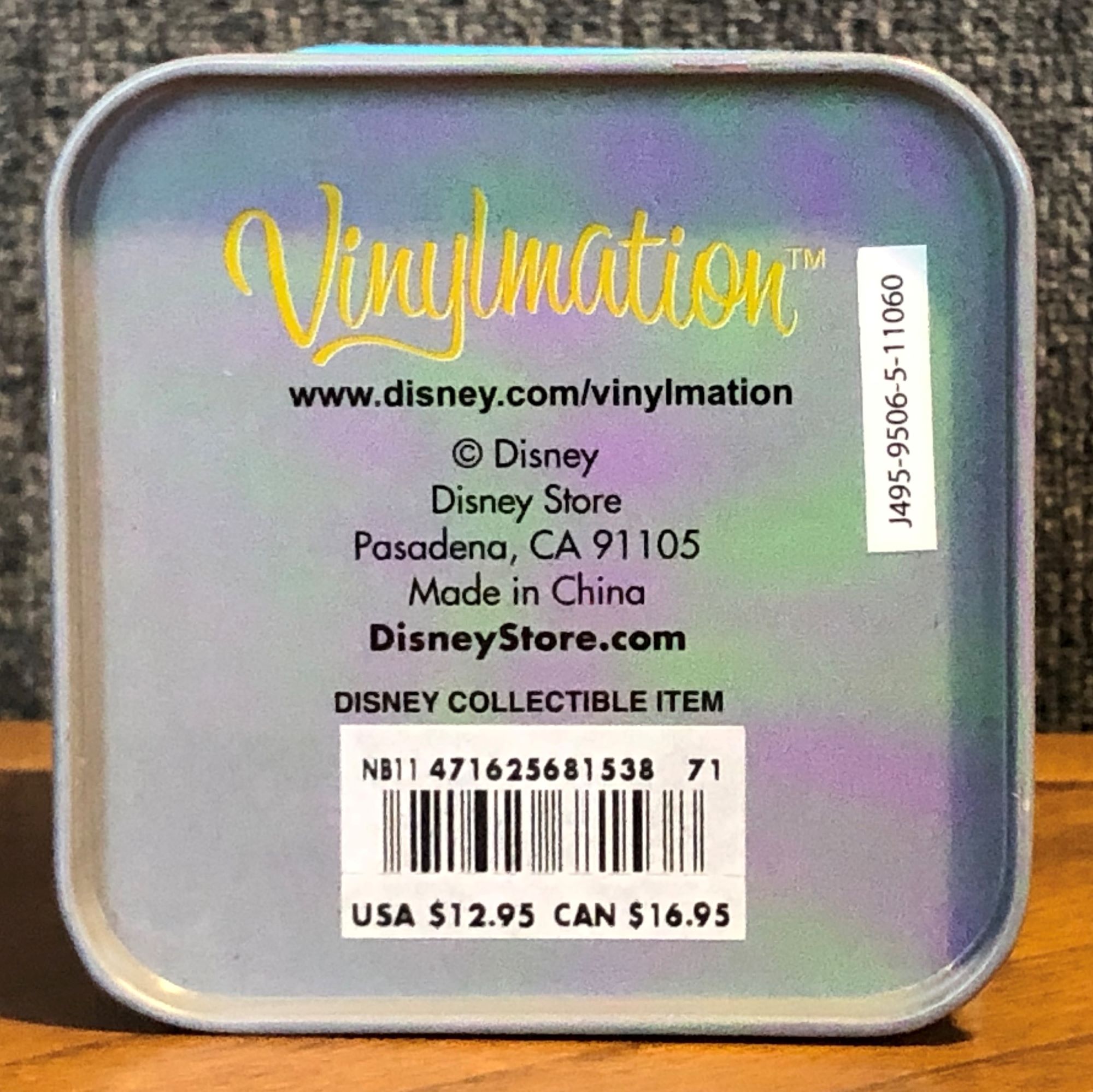
It sold for $12.95 US or $16.95 CAN which I thought was a fantastic price for such a unique item! I just love the tin with its level of detail. It’s like a crushed taxi! And note that inside the tin you have a view of the New York skyline as you would see it looking up through the sunroof of a taxi. If a taxi had a sunroof.
And how did I find such a small piece of merchandise in such a huge store? Well, this enormous Big Fig kind of caught my attention:
“What’a you lookin’ at?”
Once I opened the tin I found the information card you see below. It helps us to confirm that this Vinylation figure is indeed modeled after the Checker Company taxis, and not just the generic yellow taxis you see in New York today:
Note the front of the card on the left, above. You can see the taillights of a taxi. Do they match a vintage Checker Taxi Cab? Why, yes they do:
You can see the signature triple lens taillight fixtures on both the card and on the actual taxi itself. We can say with confidence that this was definitely the inspiration that Jim Valeri used when designing his Vinylmation figure.
Let’s have a look at it from the back side to see more interesting features:
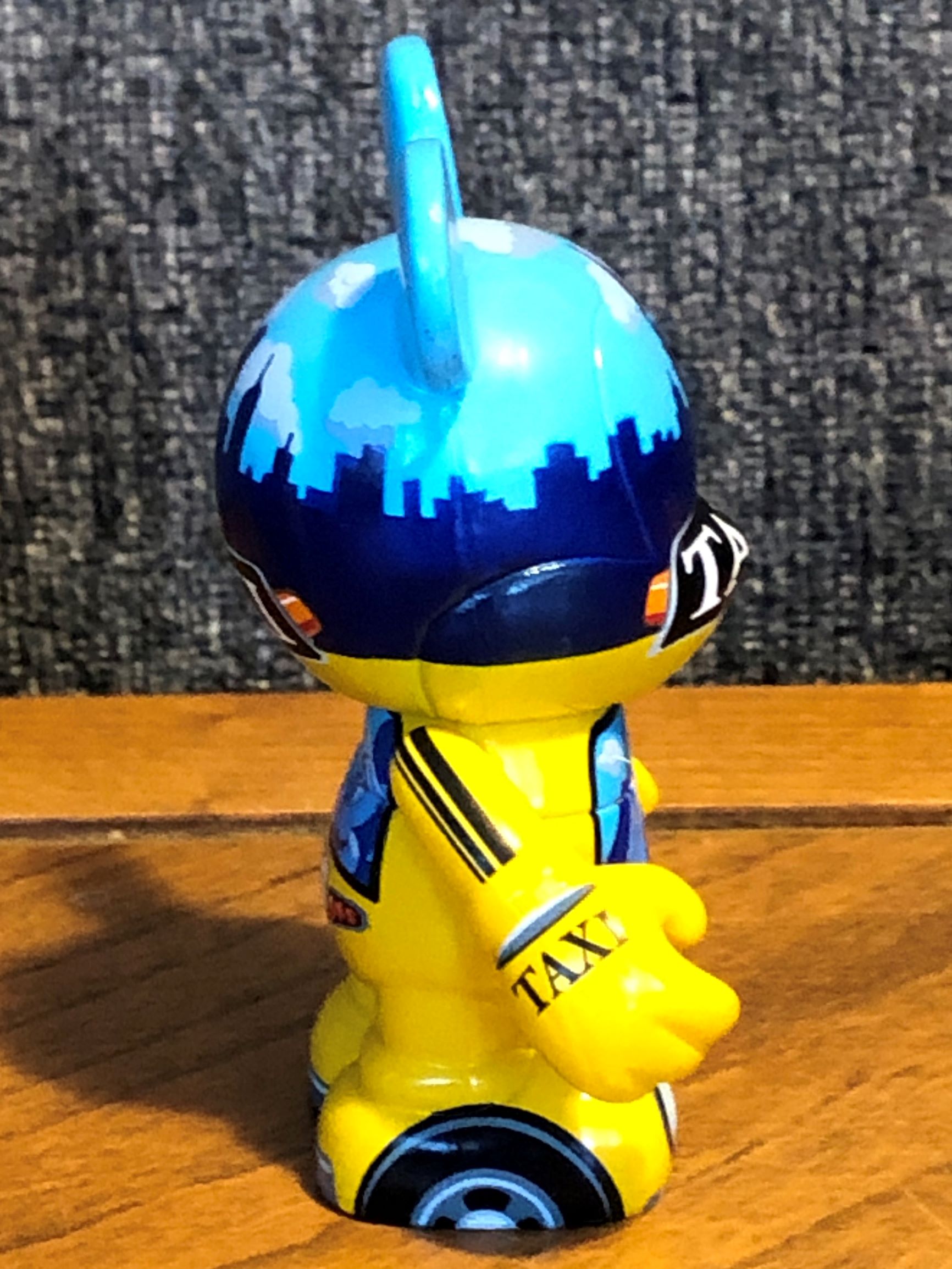
More of the New York skyline is visible with the TAXI sign again, but look who the passenger is: it’s Mickey himself with Lady Liberty! I think she is a reflection in the glass and not actually in the taxi with him. And we have the triple lens taillights again. And what car is complete without a personalized license plate?
From the side views you can see that each hand has the word TAXI on them, which would be on the doors of an actual cab. We have the checker strip on his arms. And we have the wheels of the taxi that go round and round.
Jim Valeri has done other Vinylmation figures, like this Director Mickey Mouse and a really grumpy looking Grumpy figure.
Checker Motors had trouble competing with fleet discounts offered by the larger manufacturers, as well as economies of scale in procuring components. The final models were produced in 1982. After 1982, Checker invested significantly in the third party manufacturing business, serving GM and Chrysler. It was an end of an era when this company ceased producing the iconic Checker Cab!
FUN FACTS: Many believe that the Checker Cabs got their name from the black and white checker pattern that ran in a stripe along the side of the vehicles. But it actual comes from the name of the manufacturer of the car itself, the Checker Motors Corporation. This company did operate one of the countries largest taxi fleets under the name of the Checker Cab Company, but the start of the name comes from the parent company.
























 Disleelandia