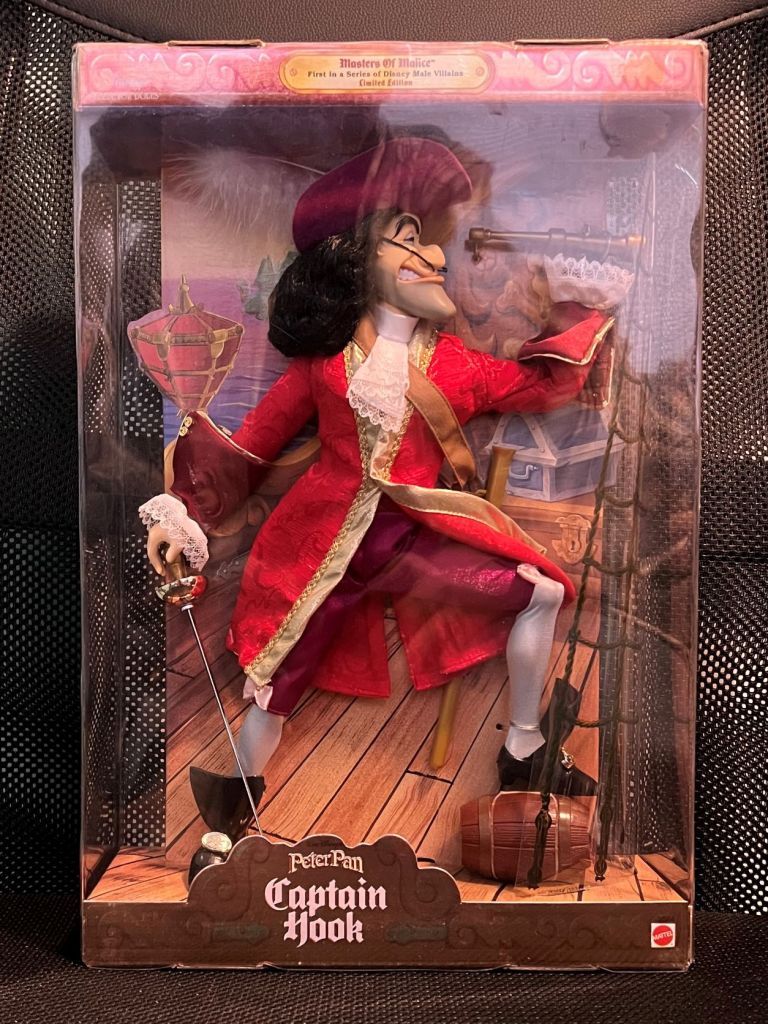
It must have seemed like a winning idea at the time. Back in 1999, Mattel released the first in a series of the ‘Masters of Malice’ dolls with Captain Hook from the animated classic film Peter Pan.
Who was the second Master to emerge? There wasn’t one. I don’t know why this line didn’t take off as it is wonderfully realized:
I’ve kept my Captain in his plastic cell, or brig, since I ‘captured’ him. It’s very tempting to let him out so his full villainy can be on display.
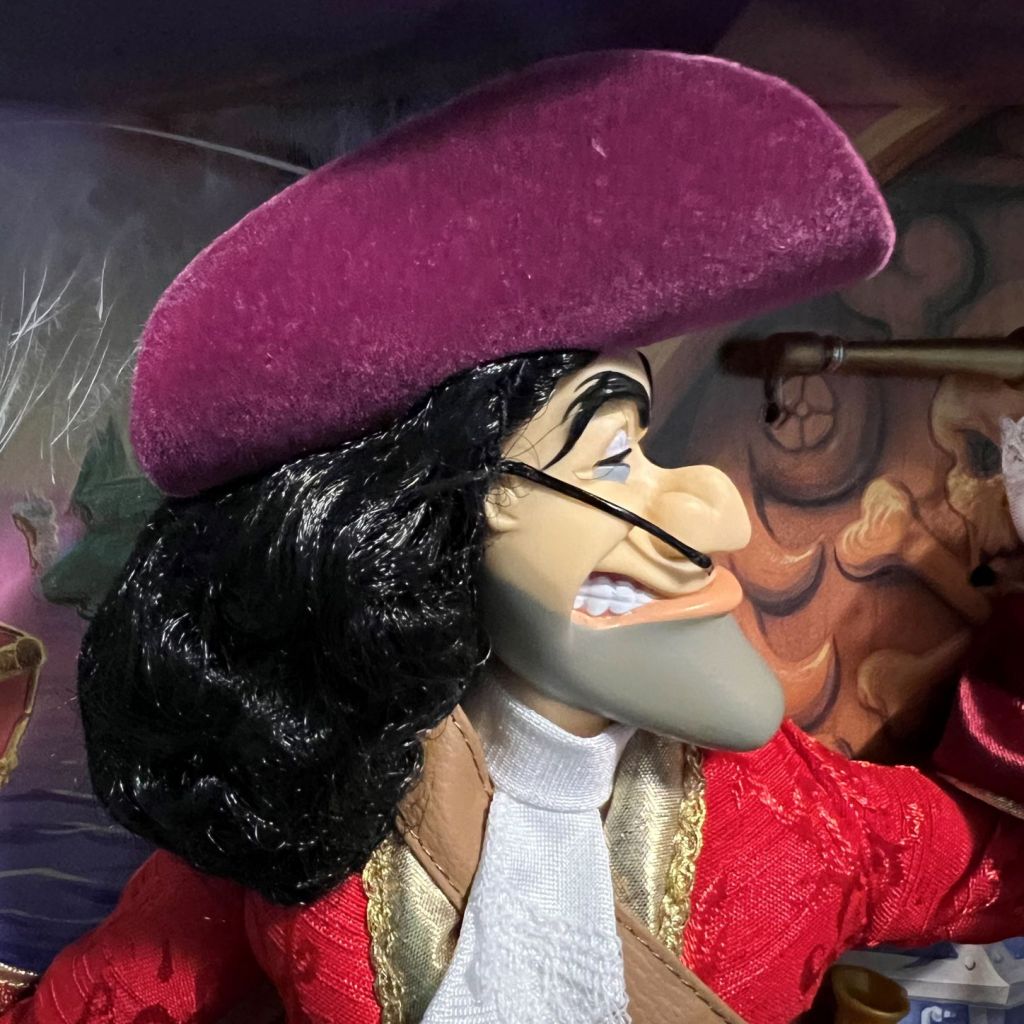
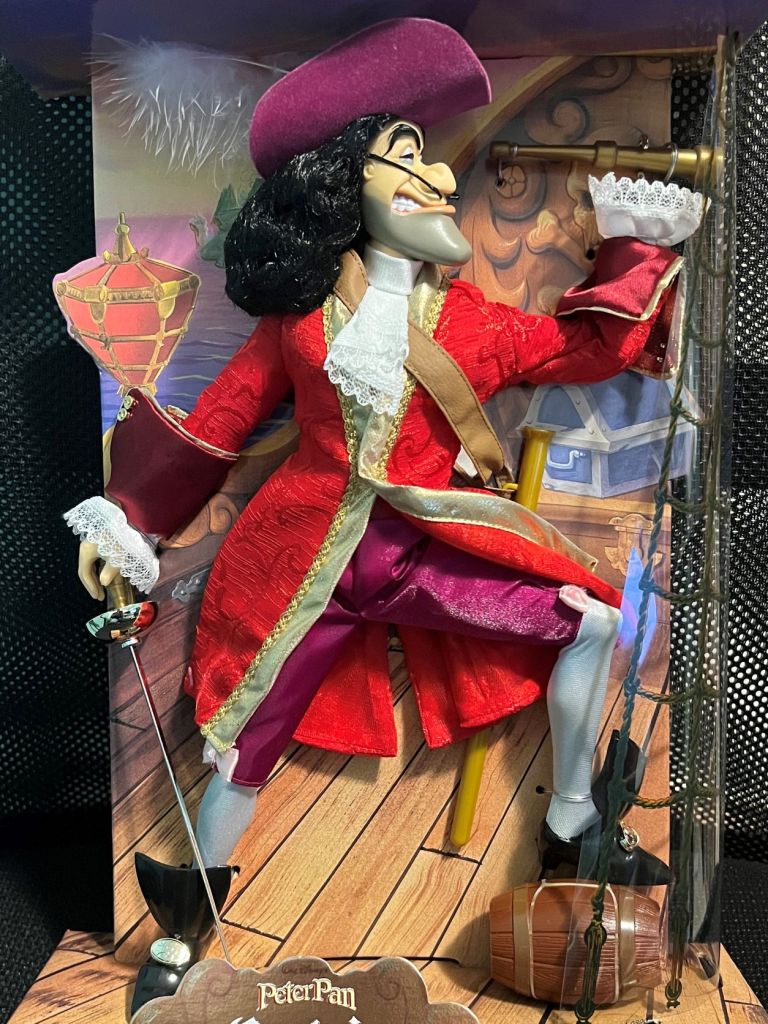
Okay, I gave him a day pass so we can get a better look at his finery and accoutrements:
The level of detail on this doll is astounding! Mattel really did go back to the source material and do it justice. Which is more than the Captain deserves. But note the shoe buckle featuring the famous pirate skull and crossbones. The lace. The hook. It’s almost too much!
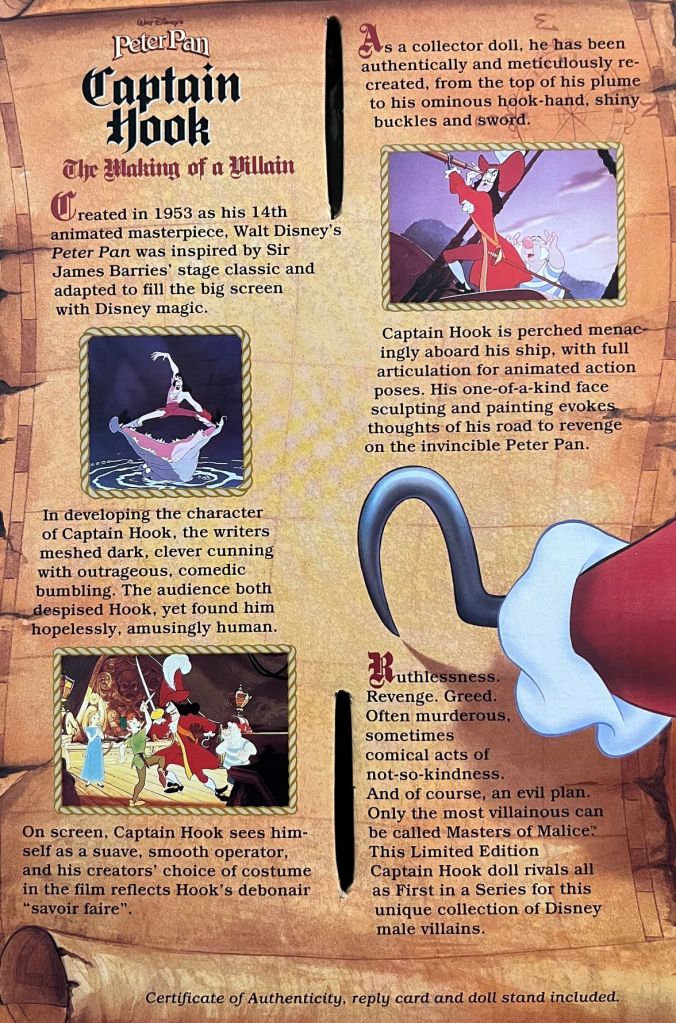
The back of the box gives a nice spiel about the movie, the character, and the inspiration that led to the making of the doll.
I can’t show you the Certificate of Authenticity without half destroying the packaging. I’ve looked on line and it appears that every other jailer of the Captain has made the same decision.
“The climax is the greatest train wreck ever filmed.” – The London Evening News
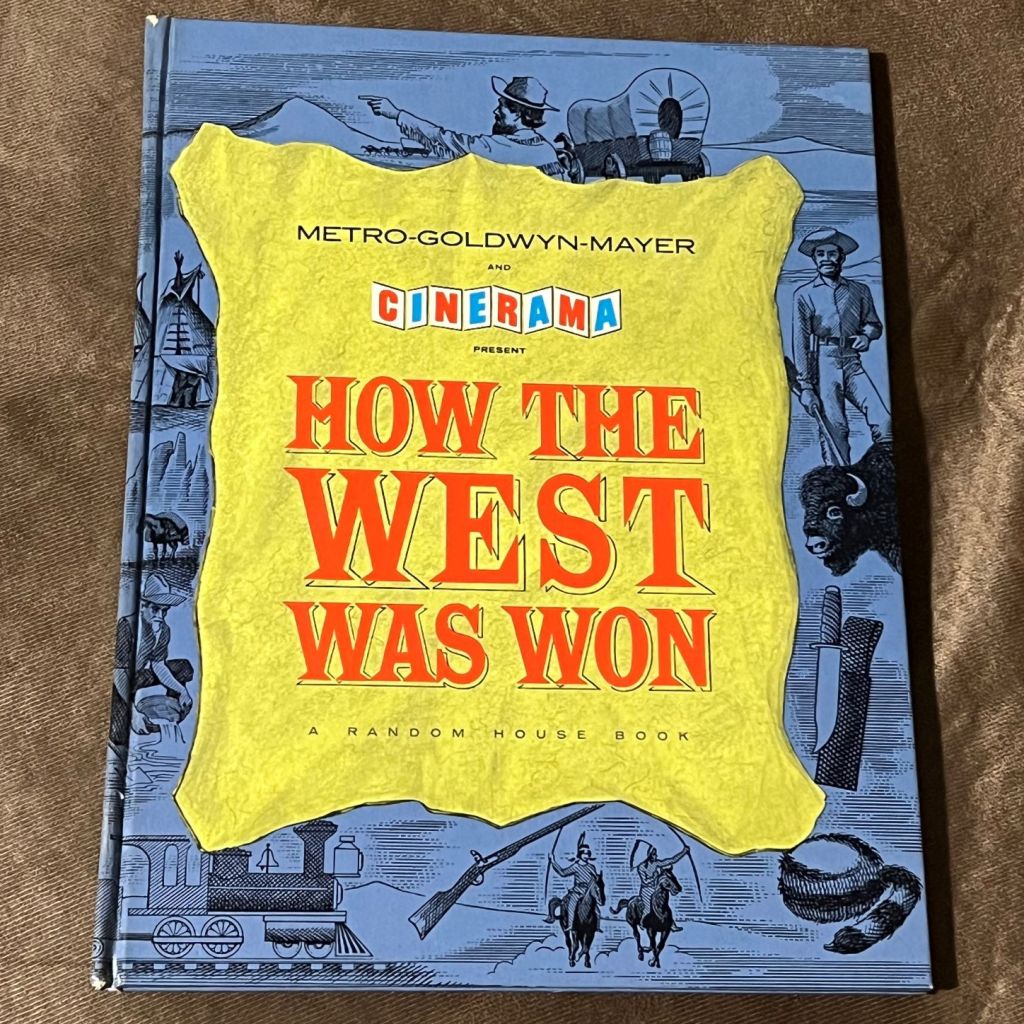
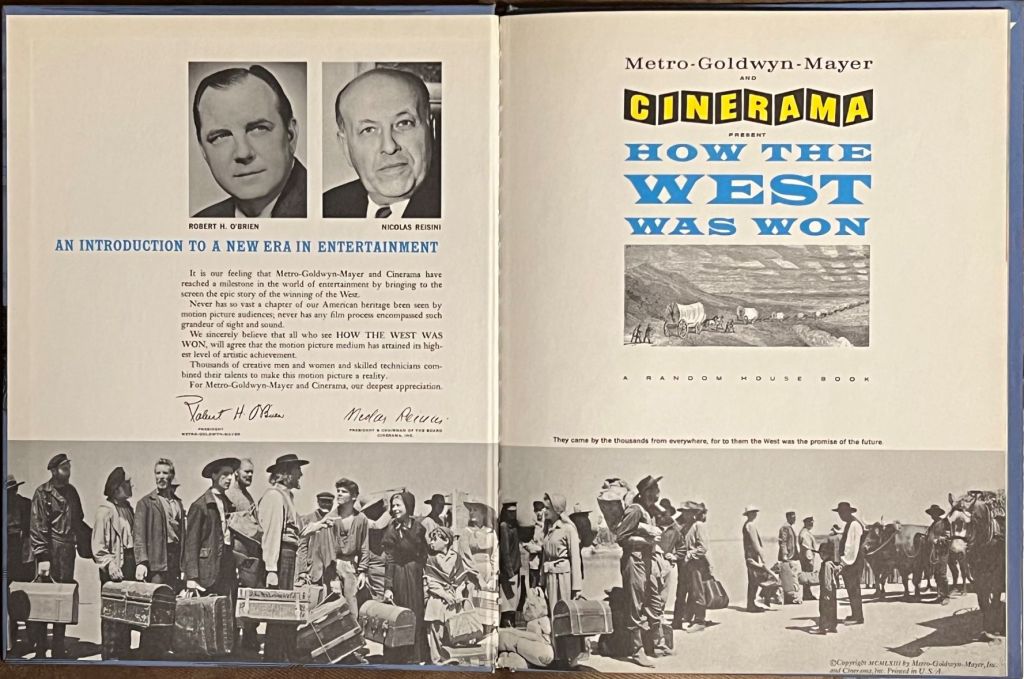
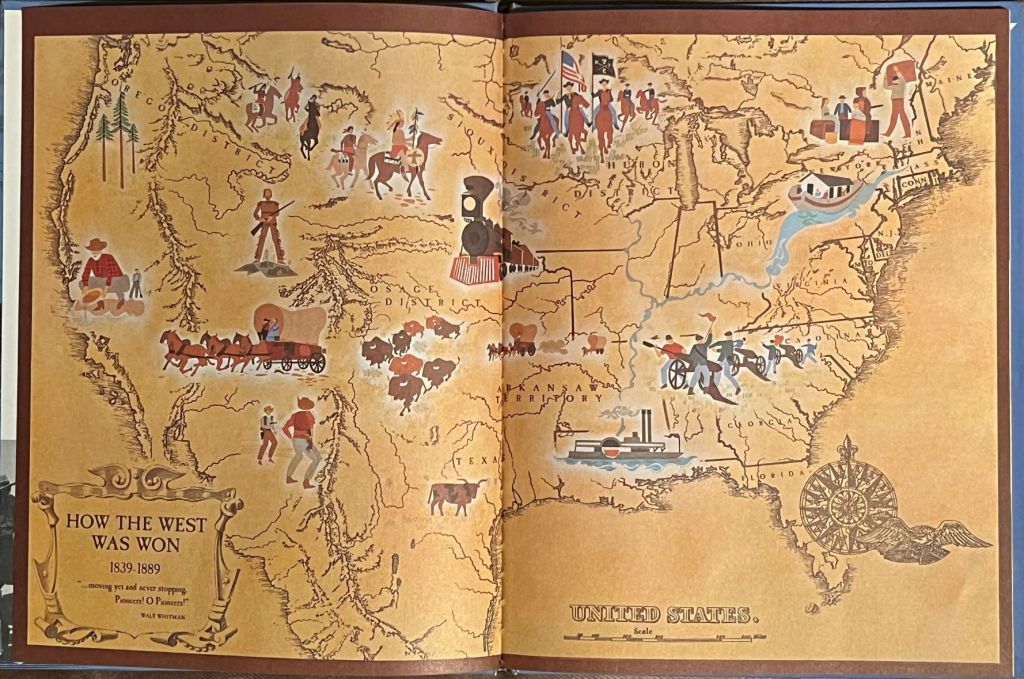
They didn’t mean that the ending of the film was terrible, but that there was an actual train wreck at end of it! I haven’t seen the film myself, so I can’t agree or disagree either way, but I do have this promotional book that was published in conjunction with the theatrical release. And if it’s any indication, How the West Was Won was definitely a blockbuster event!
I’m not sure how this publication was distributed back in the day. The year was 1963 with the film itself being released in late 1962. It could have been made available at theaters. It may even have been sold at book stores as the movie was a huge success and interest in how it was made would have been high. Also, MGM and Cinerama were looking to promote their new projection system, so this book would have gone a long way in doing that.
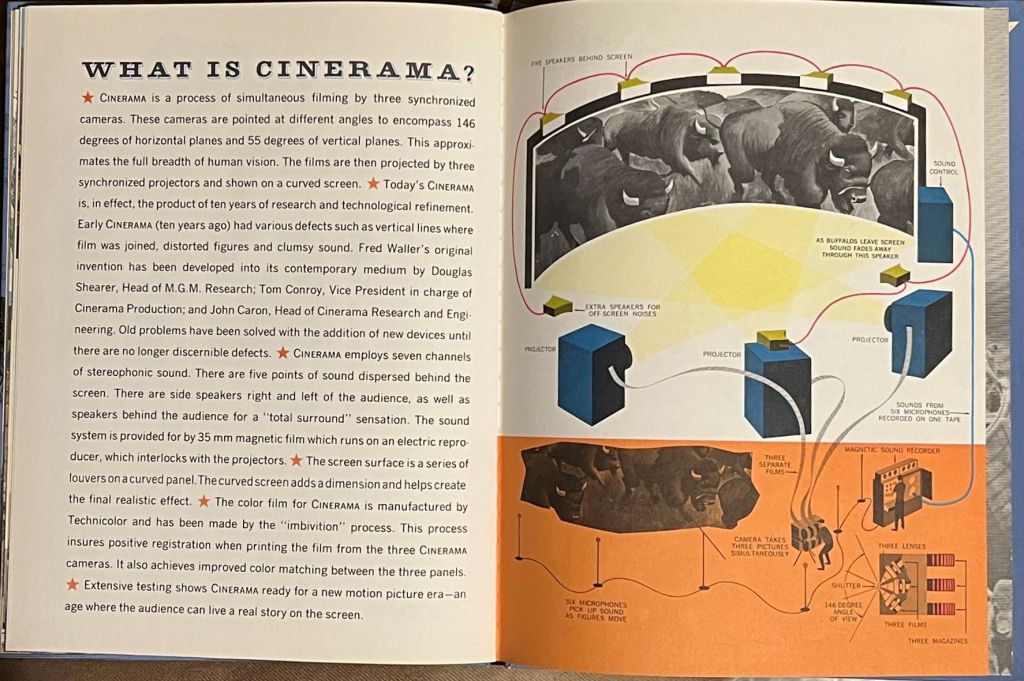
The book obviously touts the virtues of both the film and the Cinerama filming process. They used a three-camera set-up designed to provide a 146 degree horizontal coverage and a 55 degree vertical coverage of the subject being filmed. That, accompanied by multiple microphones recording the scenes from many different directions, it was designed to put the viewer smack dab in the middle of the action! The end result was said to approximate how the human eyes and ears perceived things.
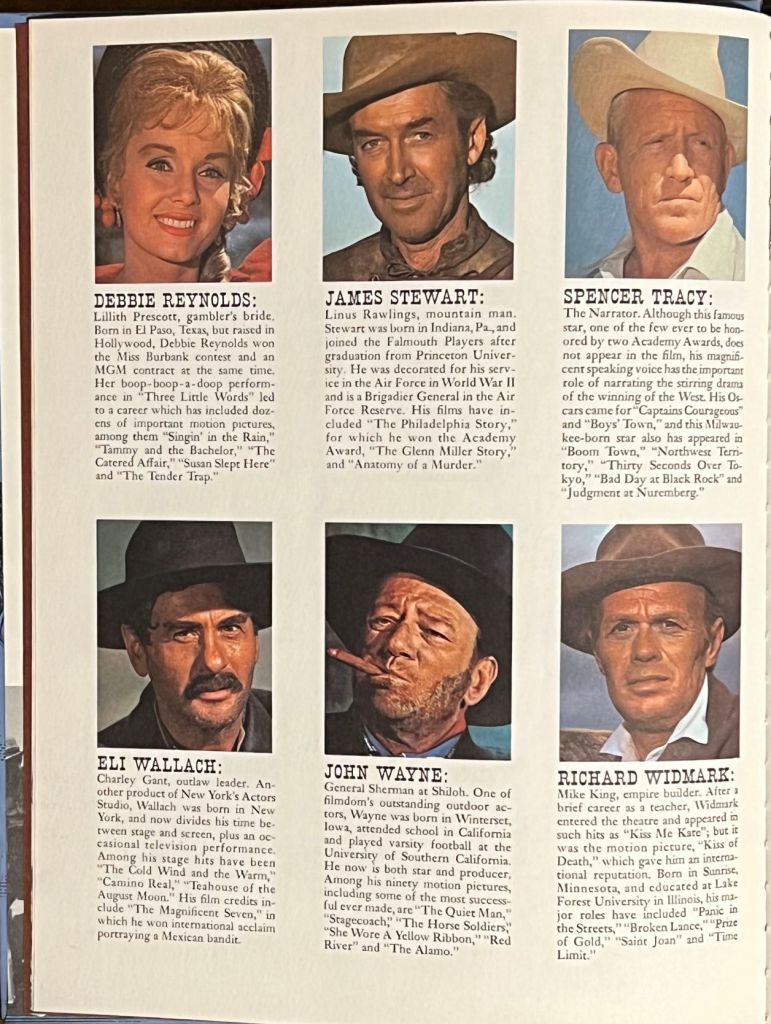
Did the film have any well-known names in the starring cast? No. It had everyone who was anyone in 1962! It even had Oscar Winners in the supporting cast!
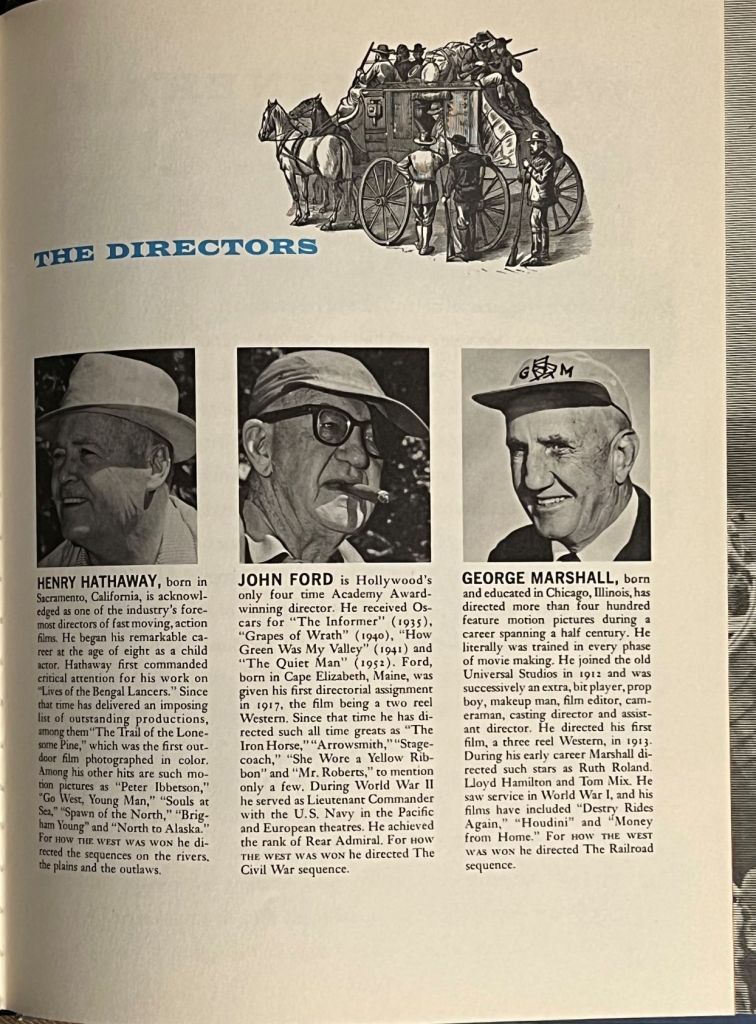
It took not one, not two, but three directors to pull this epic Western off and get it on to the screen. The problems were many but these men persevered and delivered what has become an iconic piece of cinematic history.
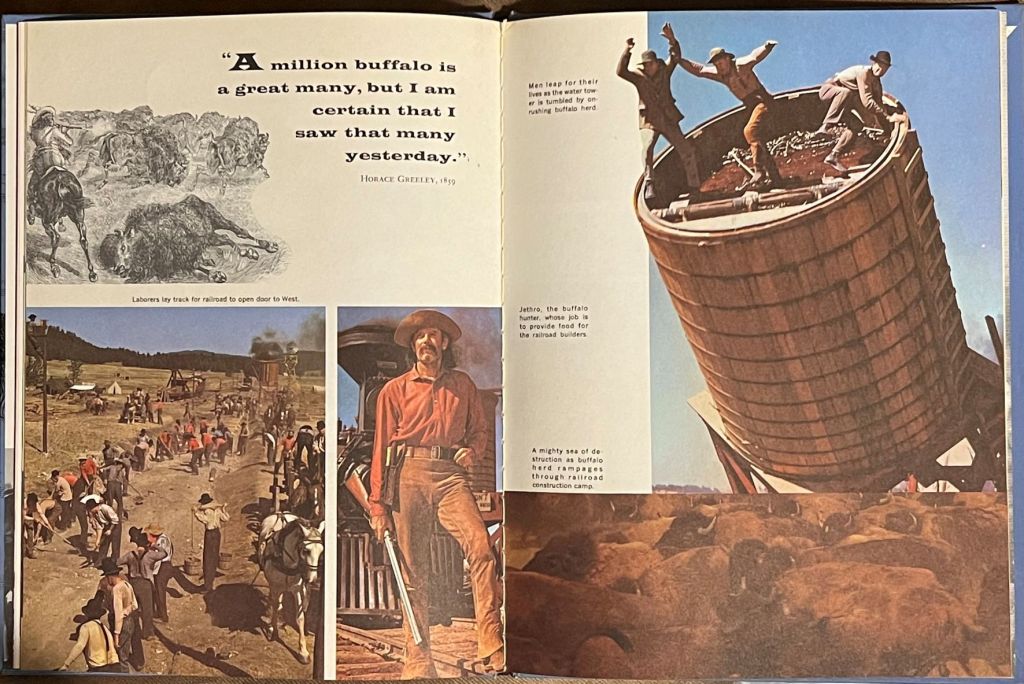
After a bit of preamble the book launches into page after page of pictures from the film with blurbs to describe the scenes. Some production notes are also shared.
And no promotional book would be complete without a page or two of incomprehensible technobabble about the processes used to create the film. This book makes Cinerama sound like the greatest thing to hit movies ever, but other sources I read gave a more realistic view of the process. It was fraught with problems and didn’t last long. Not unlike Walt Disney’s attempt to create a new system for viewing his animated classic Fantasia, and how that failed to catch on, we have a similar situation where MGM boldly said ‘Hold my beer’… and regretted it.
If nothing else, this book has made me want to watch How the West Was Won. If you plan on doing so, apparently there is a version called SmileBox, which simulates the curved-screen effect of the original theatrical release, the hallmark gimmick of Cinerama.
I would give this book a solid 4 out of 5 Stars. It is excellent for any student of film but perhaps a little short (only 40 pages) for the avid researcher.
Lions. They are large cats of the genus Panthera native to Africa and India. They hang out in prides that consist of a few adult males, related females, and cubs. And who is the most famous cub of them all?
Simba. This name literally means ‘lion’ in African. In shona, a language spoken in Zimbabwe, Simba means ‘Power’. Seems fitting!
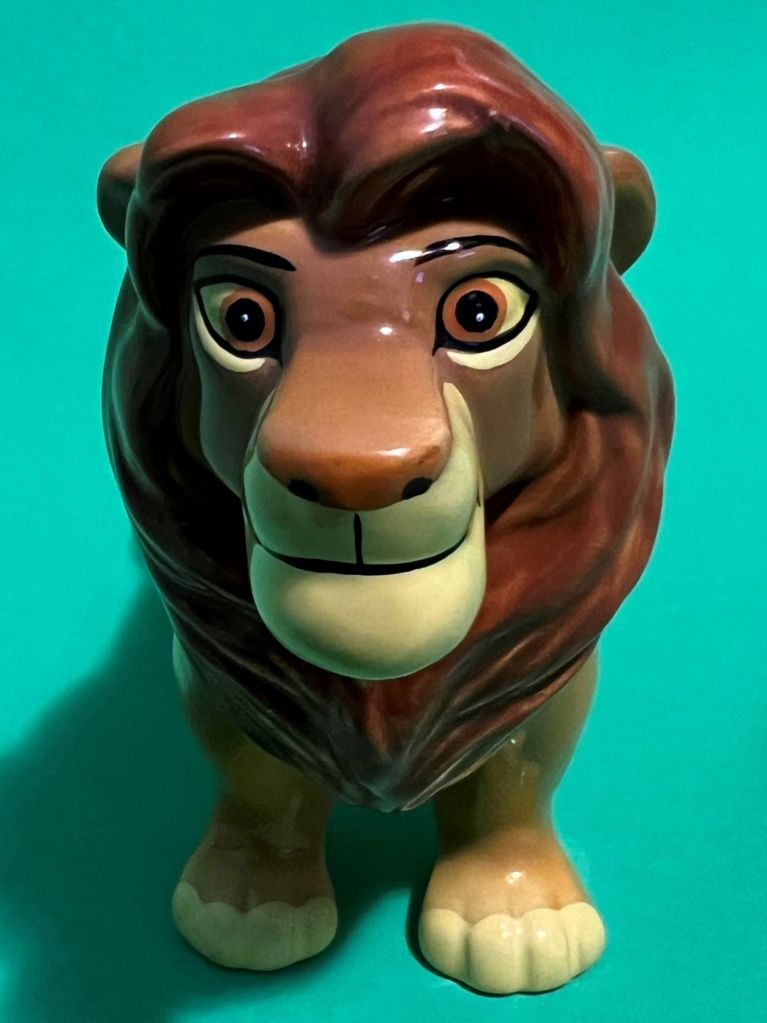
The subject of this post is the Lion King ‘Simba’ ceramic figurine:
A face anyone could love!
This figurine is fairly basic but well crafted. It is approximately 6″ long and 4″ tall. It is likely hand painted if the facial features are any indication.
Simba bears no trademarks or manufacturers stamp. So who produced it and when is all but impossible to ascertain. One can only assume it was part of a larger set featuring other key characters from the animated film.
Check out this plastic Simba Bank, or Simbank, owned by our occasional contributor, Nick.
When I was frequenting Walt Disney World, I was a merchandise fool! My vacation was half attractions and half buying stuff. After a while, I had to slow down to give my pocket book a chance to recover. But I still wanted to get something to remember each trip by!
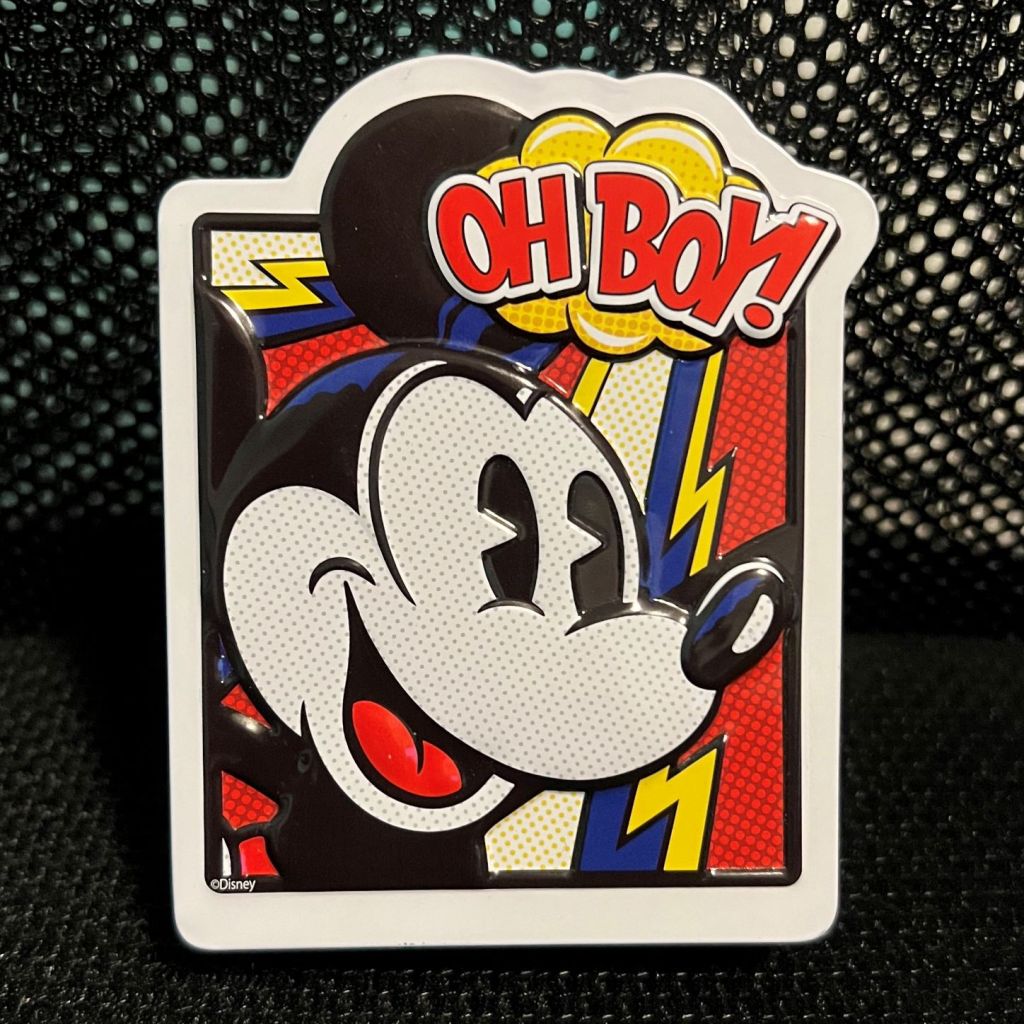
Enter the inexpensive Disney Parks ‘Oh Boy!’ Peppermint Mints tin:
These little mints are great for carrying around the Parks. If you get a little peckish you can pop a few in your mouth and they will tide you over until your reservation for a meal is available.
This tin really stood out for me! The artwork is dynamic and colourful. I don’t know what the artist was going for, but I think Mickey is having a Brain Storm!
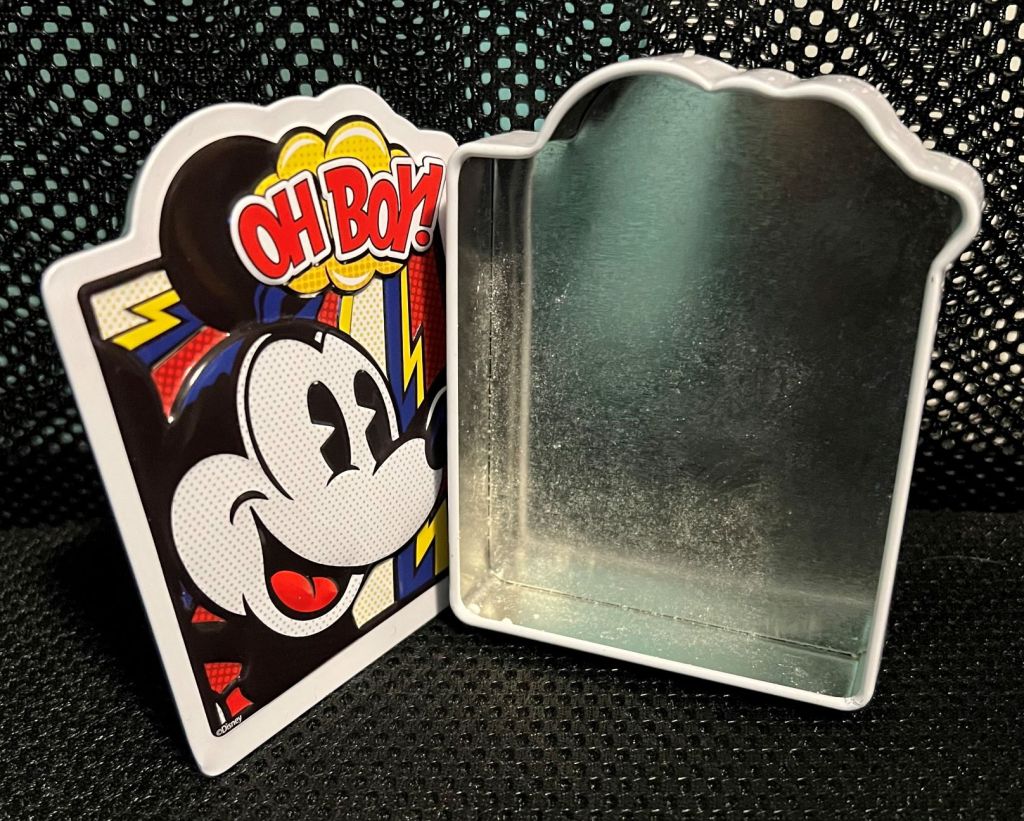
Most candy tins at the Disney Parks open on a hinge. This one has a lid that has to be pried off. It is quite thick, almost like it is intended to be insulated, which isn’t the case.
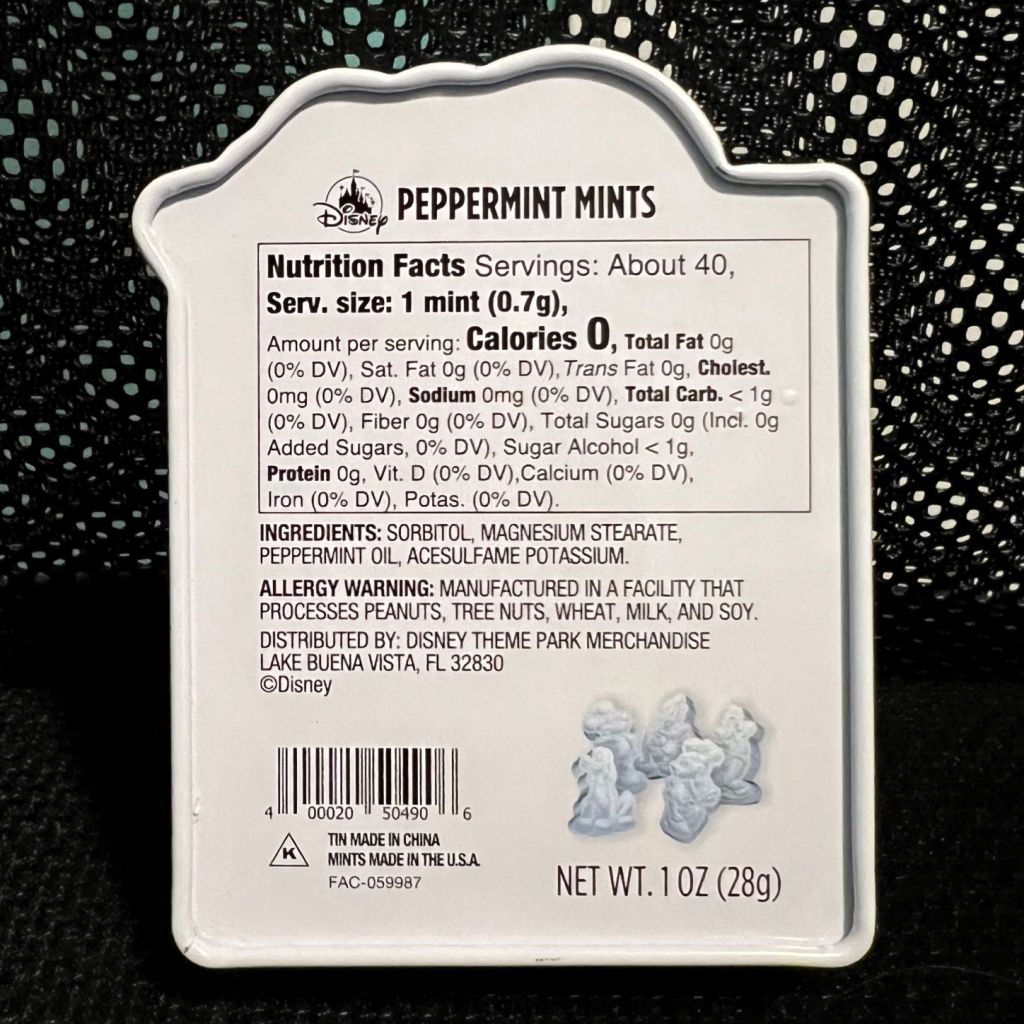
By law every food item must list the nutritional facts and ingredients. Fair enough. But do I need to know that it doesn’t have any fat, sodium, fiber, sugars, protein, calcium, iron, or potassium? No. No I don’t. Just tell me what it does have! In this case: 1 lonely gram of carbs.
But nothing says “Yum!” like good ol’ magnesium stearate! It’s also got that.
For more fun with little metal tins with mints in them, check out my earlier post featuring a whole bunch of Collectible Souvenir Candy Tins.
Donald Duck has had so many occupations. Some could arguably be said to have been a good fit for our ill-tempered friend.
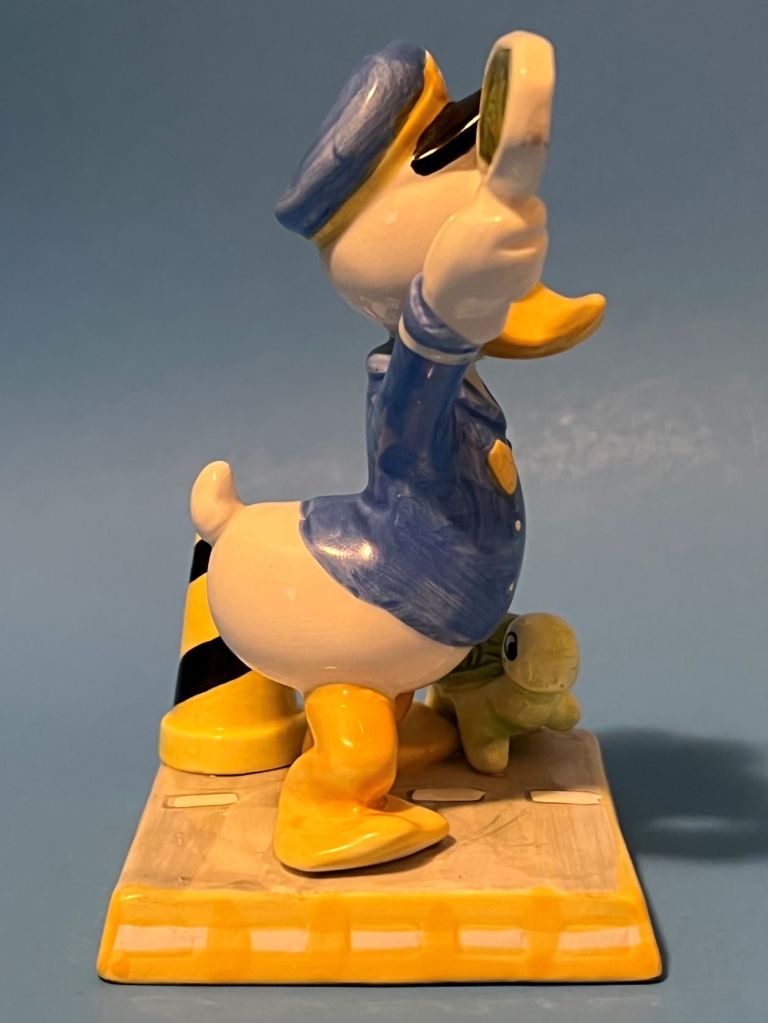
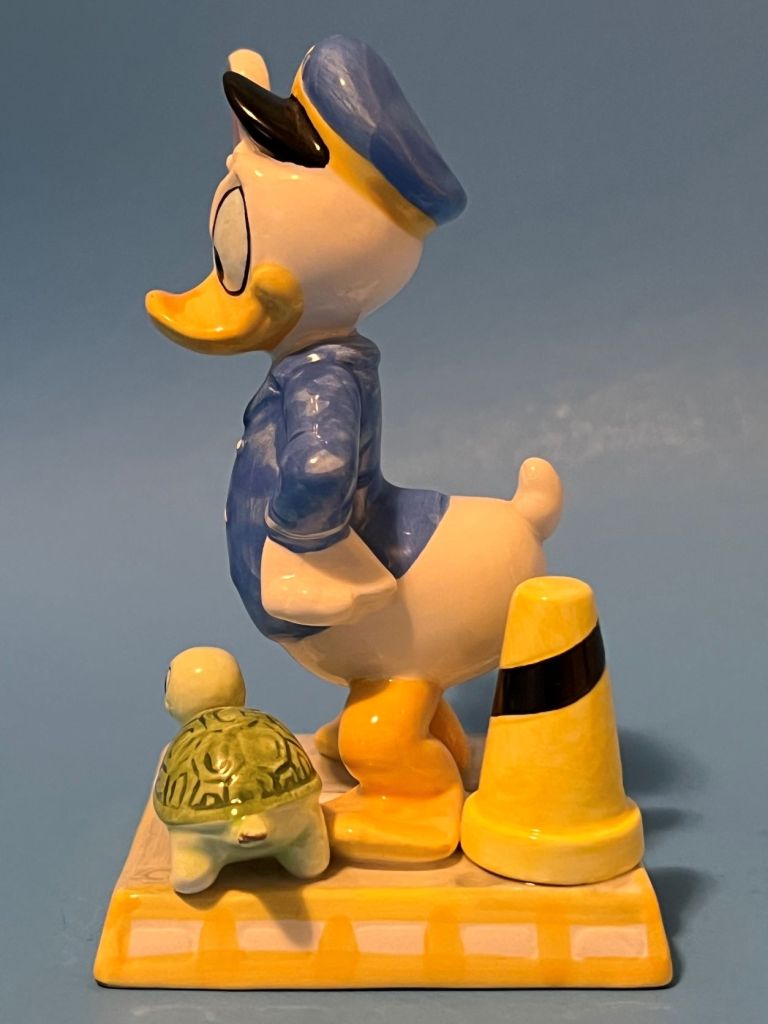
And then there is the Schmid Donald Duck Crossing Guard figurine, and we are introduced to one occupation that is definitely not suited to a duck with zero patience:
If you look closely you can see what looks like an expression of one who is a bit perturbed. This might not be entirely Donald’s fault, as the little turtle is probably taking his time crossing the road!
If you look closely from the side however, it looks like Donald is actually smiling! Maybe the cuteness of the turtle has melted his heart and put out the fire of his trademark anger?
The Walt Disney Company is a trademark used since 1986, so this figurine is from after that date. It was made by Schmid and manufactured in Taiwan.
Maybe if Donald wants the turtle to hurry it up, he should turn the sign around to say ‘GO’ instead of holding up the ‘STOP’ side!
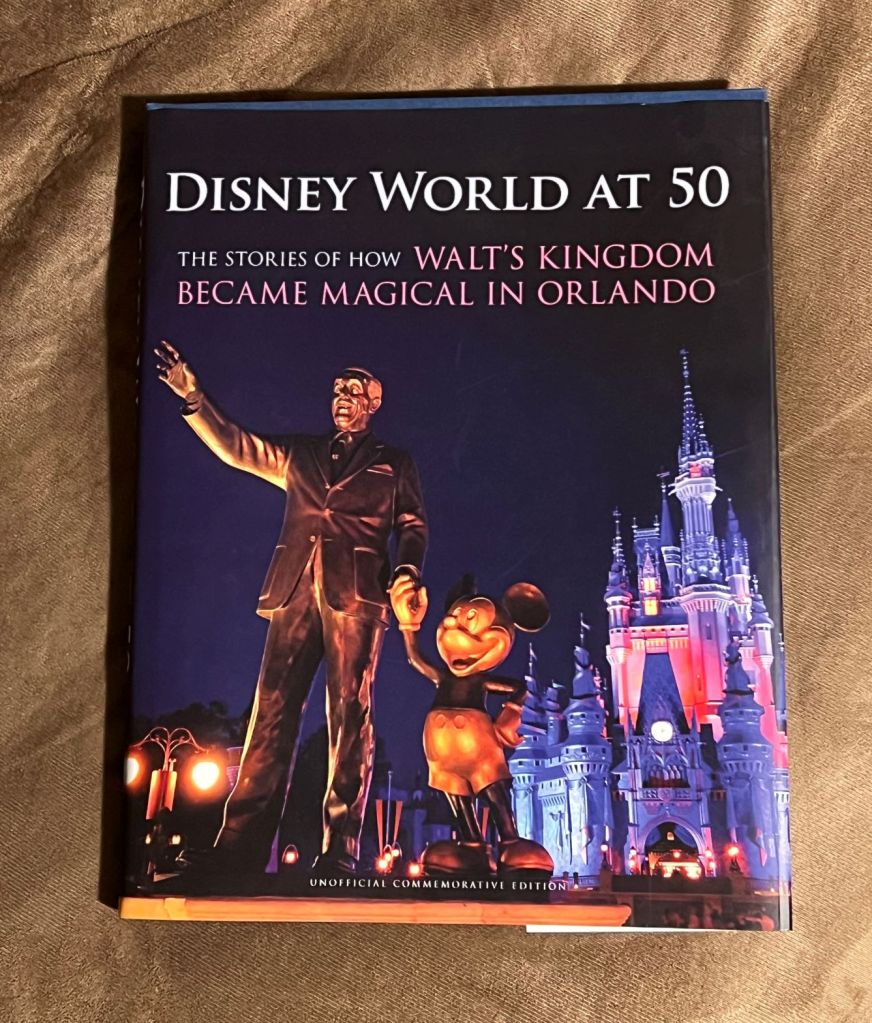
“Because 50 years later, we’re still Mickey’s neighbors.”
Walt Disney World opened in Florida on October 1st of 1971. The Orlando Sentinel newspaper was there to cover the construction, the opening, the first years, and is still there today, covering all that is newsworthy about Walt’s second Park.
This book covers Walt Disney World in a way not done before. Instead of creating a narrative through new interviews and turning those into a single story, it simply reprints articles and images as they originally appeared in the newspaper over the years.
Each article gives the original date of publishing, the author(s), and at least one image from that time.
As you can see from the two images above, the book is a time capsule that you, the reader, gets to open. I enjoyed it as it gave me details about the people and the attractions as they were. As a historical reference, this book is a gold mine for the amateur Disney historian!
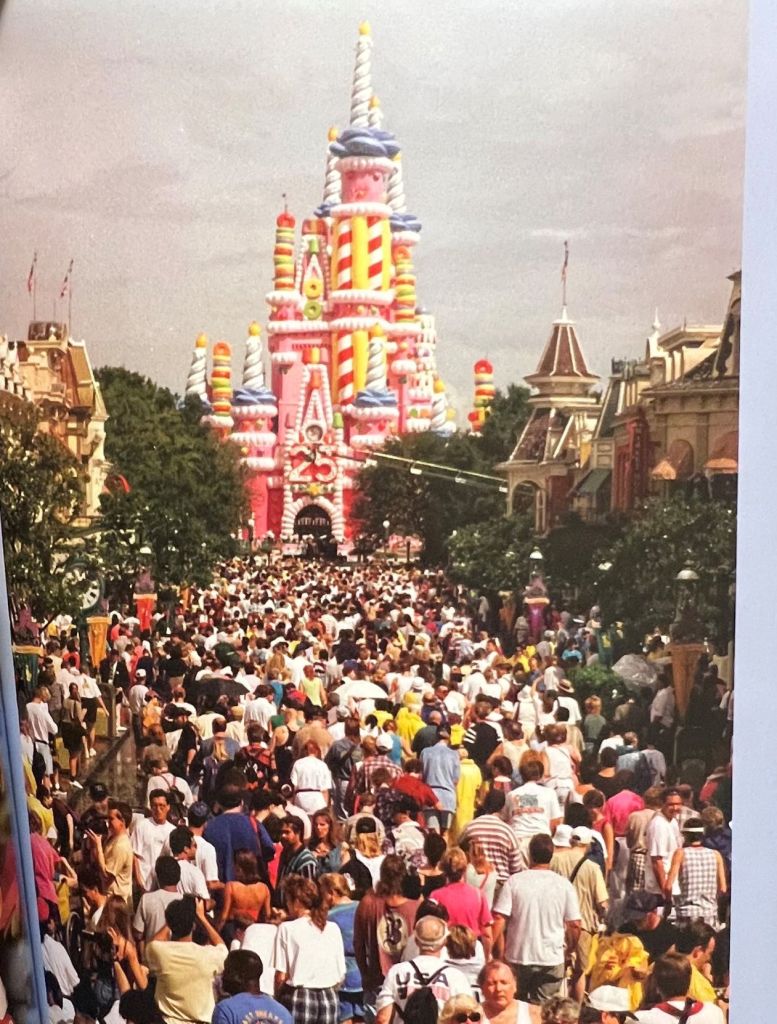
I apologize, but I couldn’t resist inserting an image of the infamous Birthday Cake Castle! This is as good a time as any to mention that it appears the Orlando Sentinel has been firmly on Team Disney from the start. Every article is upbeat and casts WDW in the best possible light. Even this much hated pink monstrosity!
The only exception was an article about Disney’s Animal Kingdom that featured interviews with actual Park guests on opening day. Let’s just say the reviews weren’t good. But again, this was the only time I found anything negative.
To get an idea of how other media sources were handling the opening of Walt Disney World, check out my earlier post that outlines what the people of Florida thought about Disney coming to the area and how Life Magazine covered it.
There is way too much in this book to share here! It is filled with fascinating facts that even an uber fan such as myself didn’t know. So the book should appeal to even the most jaded and well-read Disney fan.
What I found interesting was just how many times the newspaper was able to cover things that Disney would never allow to be exposed today. A case in point is found in the two images above where we are introduced to the man who played Mickey Mouse when WDW opened in 1971. His name was Doug Parks, and we not only get his name, but a picture of him as well!
Today, Cast Members who play Disney characters are not allowed to grant interviews or post about their roles. Times change.
The book ends with coverage of WDW during the Pandemic. Above, you can see a picture of the abandoned parking lot for the Magic Kingdom. 2021 was the 50th Anniversary of WDW and that put the celebration right smack in the middle of a worldwide shutdown!
I thought the recreation of the famous welcoming of Walt to Florida by Gov. Lawton Chiles (originally Gov. Haydon Burns) was really inventive. It was staged for the 25th Anniversary of WDW. Walt’s nephew, Roy E. Disney, standing in for Walt, certainly had a sense of fun!
I would give this book more than 5 out of 5 Stars if I could! Again, anyone interested in the history of Walt Disney World and in getting the facts straight should find it more than informative.
FUN FACTS: For more than one of the Parks within Walt Disney World, both balloons and birds were released as part of the spectacle. But did you know that they tied colored streamers to the tails of the birds?!? Who does that?
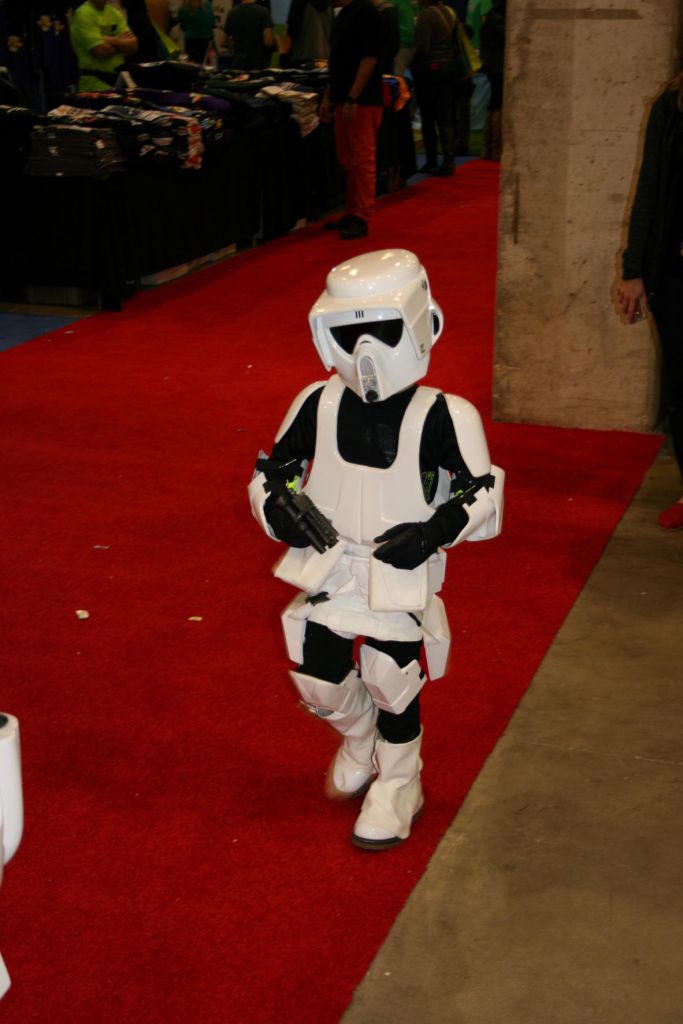
Cosplay is a big industry now and something that goes beyond the stereotypical geeks and weirdos. As more and more adults embrace their inner child, you’re more likely to see grown men and women dressed as their favorite fictional characters.
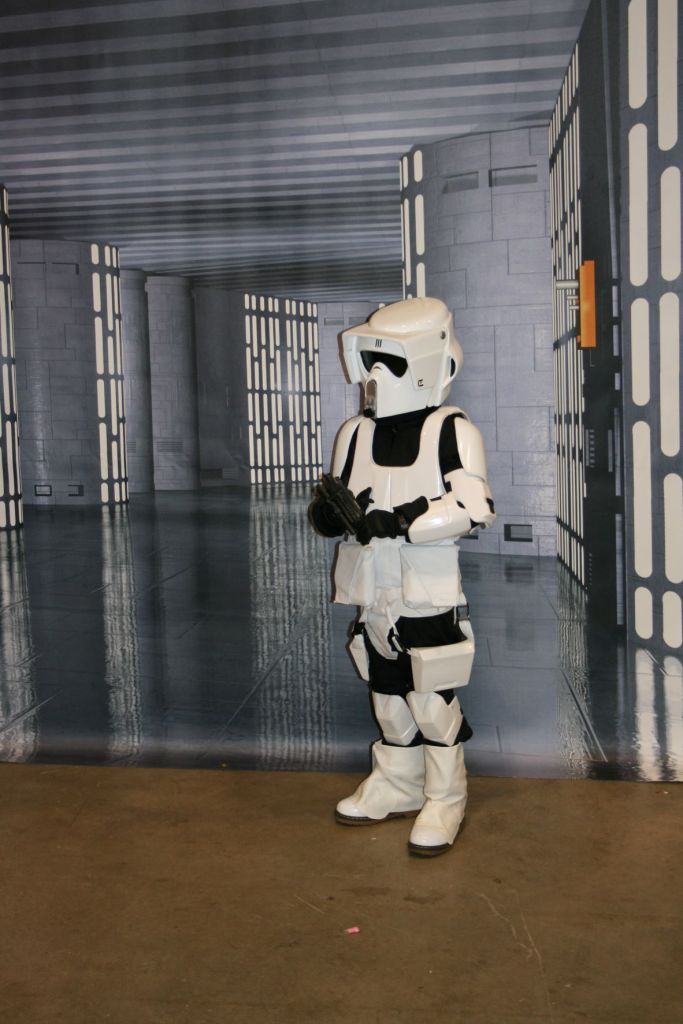
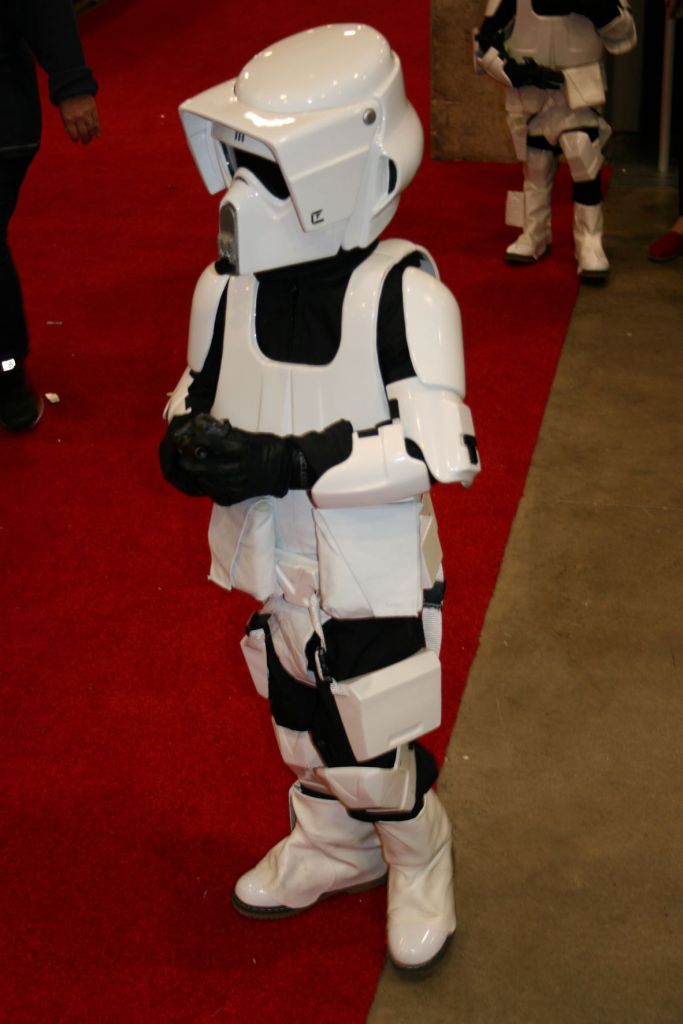
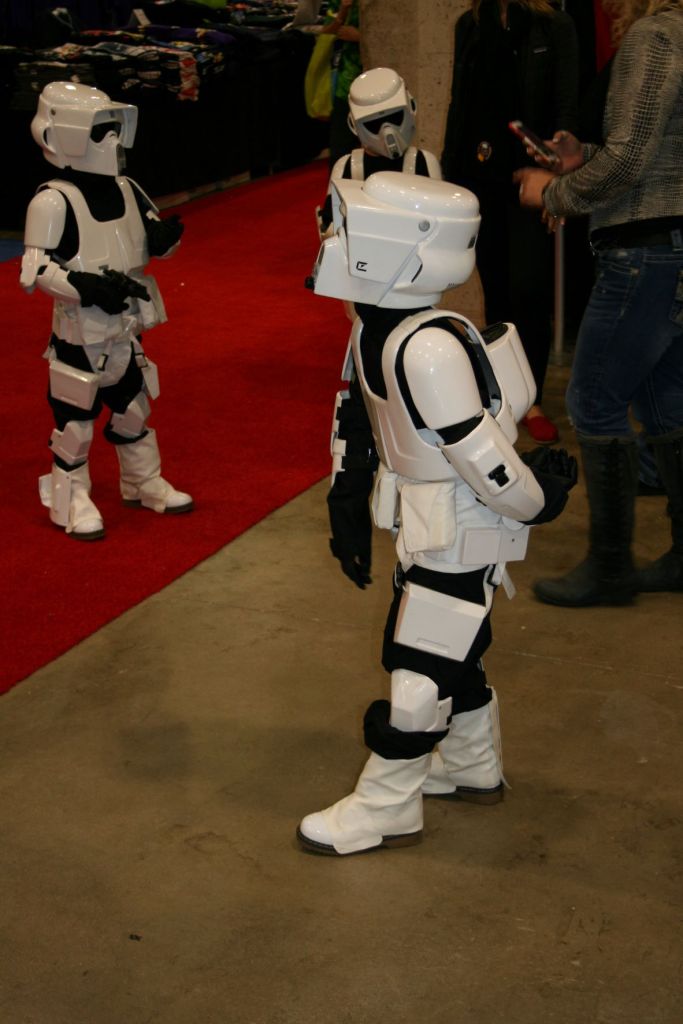
And some youngsters obviously have the coolest parents in this galaxy or even the one that is far, far, away:
I went to the Chicago Toy Fair in 2016 and came across the mini-Stormtroopers you see above. They were killing everyone with cuteness!
If these little guys are better shots than their full-sized counterparts, no kneecap will be safe!
Dick Tracy was released as a live-action movie in 1990 by Touchstone Pictures. It’s based on the comic strip created by Chester Gould and was directed by Warren Beatty, who also starred as the main character.
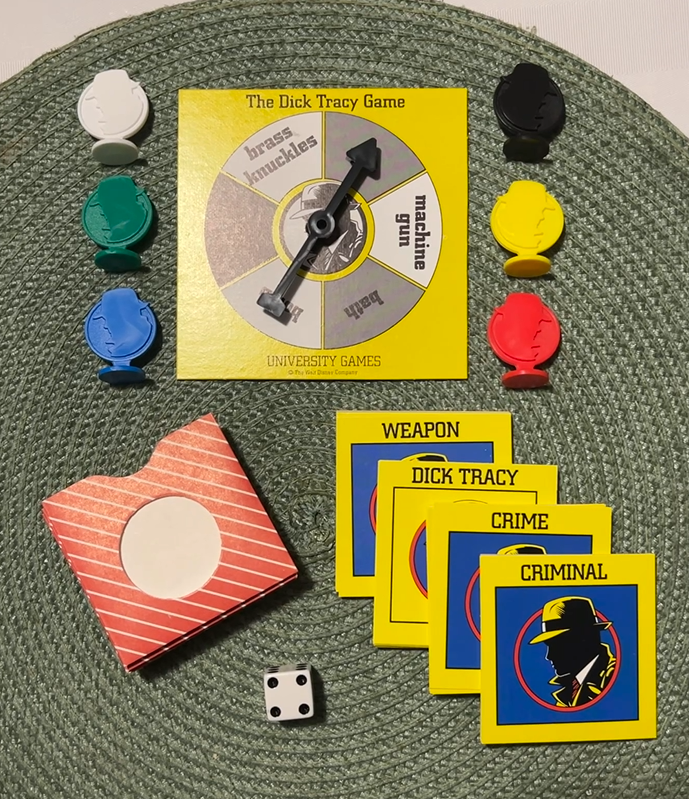
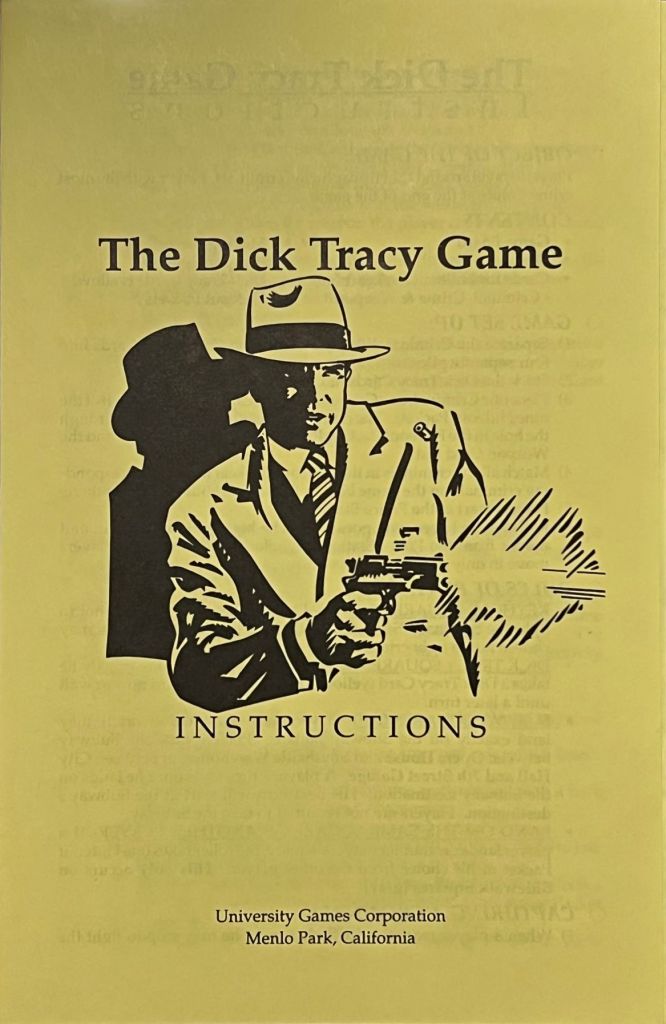
Did it do well at the Box Office? Yes. Was it critically acclaimed? Well, it won three Academy Awards. Was it fun? Yup! Does anyone remember it? Nope. But it did spawn quite a few pieces of merchandise worth taking a look at. Case in point is Disney’s The DickTracy Game by University Games:
Circa 1990
The standout feature of this game are the graphics. They pay homage to the original artwork of the comic strip while updating things a bit to match the new movie look.
The board is a basic design where you move tokens around a path the number of spaces determined by the throw of a die. This game uses cards to determine further movements and outcomes.
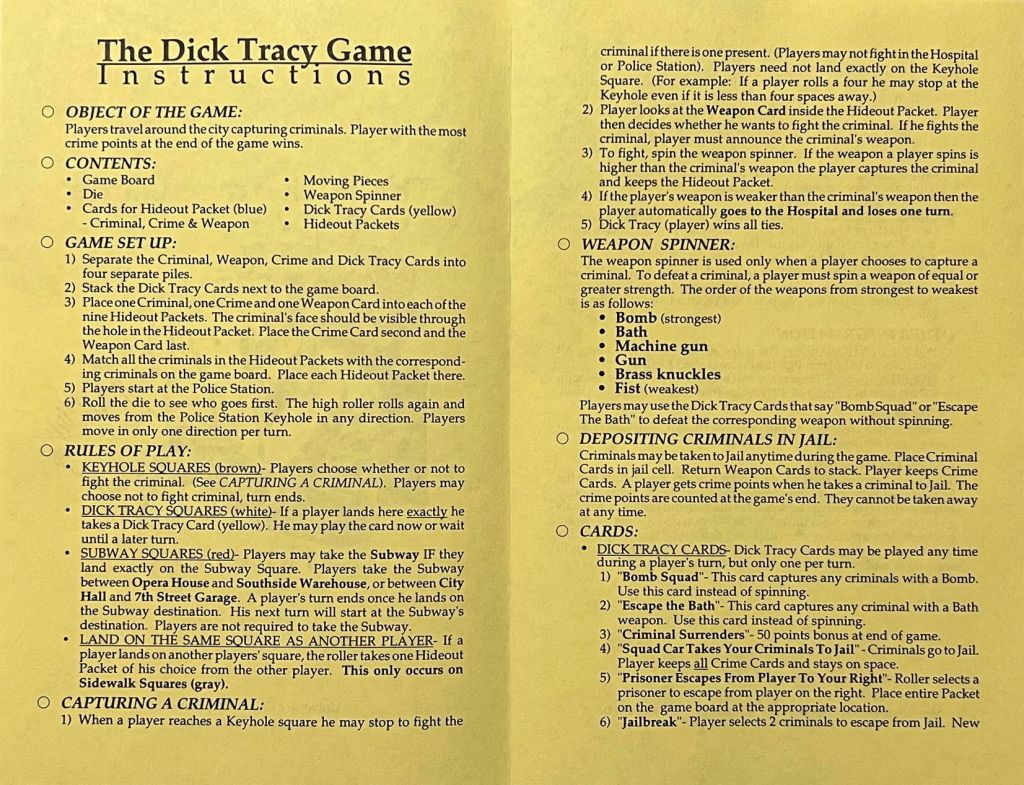
Speaking of how to play, check out the instructions:
To summarize: You catch criminals to get Crime Points with which you win the game. A cool element of play is the Hideout Packets wherein you place a Criminal Card, a Crime Card, and a Weapon Card, in that order. During play, you can choose to fight a criminal. If you do so, you open the Hideout Packet and check what weapon he has. You can chicken out at this point! If you choose to go ahead and fight the dastardly villain, you spin the Weapon Spinner and hope to land on a better weapon than the criminal. If you do, you win, and he is captured. If you lose, you go to the Hospital and lose a turn.
The rules are too numerous to completely summarize here but suffice to say you use other cards to move yourself forward to ultimate victory. The game ends when all of the criminals are captured.
This game is for ages 8 and up and 2 to 6 players can enjoy the crime spree!
Will we ever see a sequel? It doesn’t look promising as Warren Beatty has been embroiled in legal battles over the rights to the franchise ever since the first movie came out. The last time we’ve heard anything about a sequel seems to be from 2016. For all intents and purposes, it looks like the criminals have managed to beat Dick Tracy after all, at least cinematically!
FUN FACTS: One of the most famous characters from the movie, Mumbles played by Dustin Hoffman, isn’t represented in the game.
As is usually the case with these older toys, it is almost impossible to track down information about the companies that produced them. Most of them are out of business this far past the release dates and even the all-knowing Internet can only tell us so much.
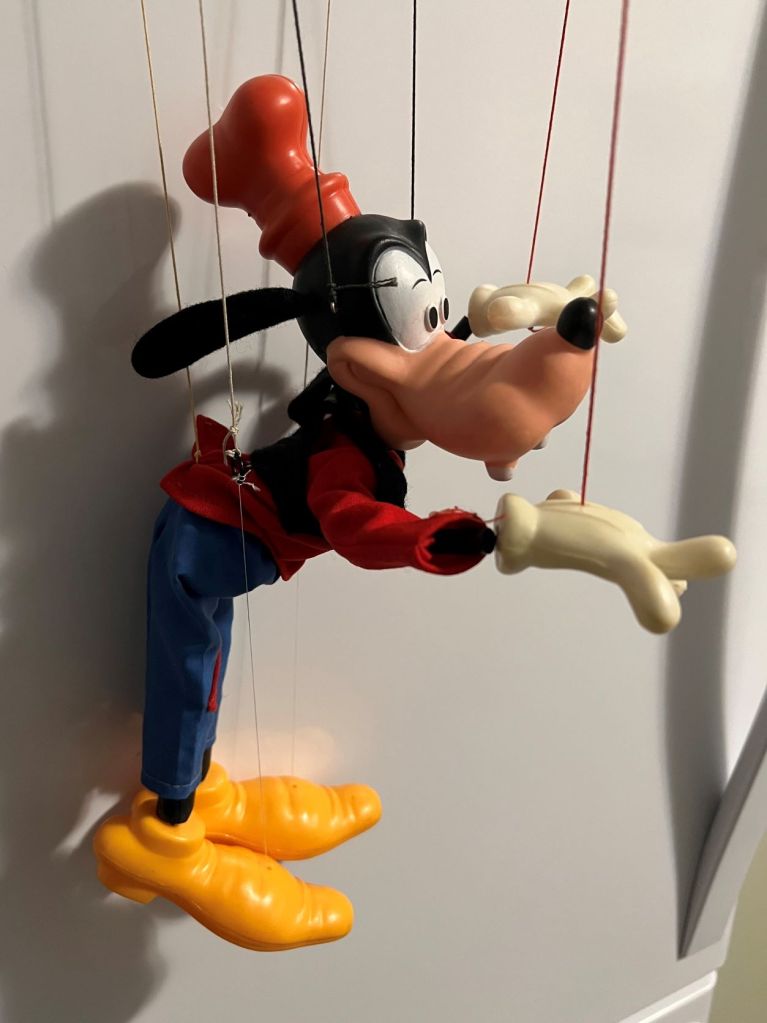
But I did my due diligence with this Disney Goofy Marionette by Madison Ltd. and did come up with some tidbits of interest.
Madison Ltd. produced many of these 11″ marionettes in 1977, including this Goofy and at least Mickey, for sure. I don’t know if Minnie or Donald ever got a version for themselves. But several of the DC Comics superheroes did, such as Superman, Batman, and Wonder Woman.
So, although the company may be gone, I did find a picture of their logo:
Each of these marionettes would have come in a cardboard box with a clear window to display the figure within. It seems yellow was the colour of choice for these boxes, at least for the DC characters.
I did also find a few other examples of this Goofy figure online. Some seem more upright than mine, which would make moving him an easier task. I believe that the controller for my marionette was broken at some point and the puppet was restrung. This would account for the hunched over posture of my Goof.
Having played with this marionette for a while, I can’t believe any child would have been able to control it with any measure of success! My performance was more akin to FrankenGoof than Disney’s beloved buffoon. If you have a few minutes, check out my first attempt at puppeteering:
Hmm. I don’t think the Jim Henson crew have anything to worry about!
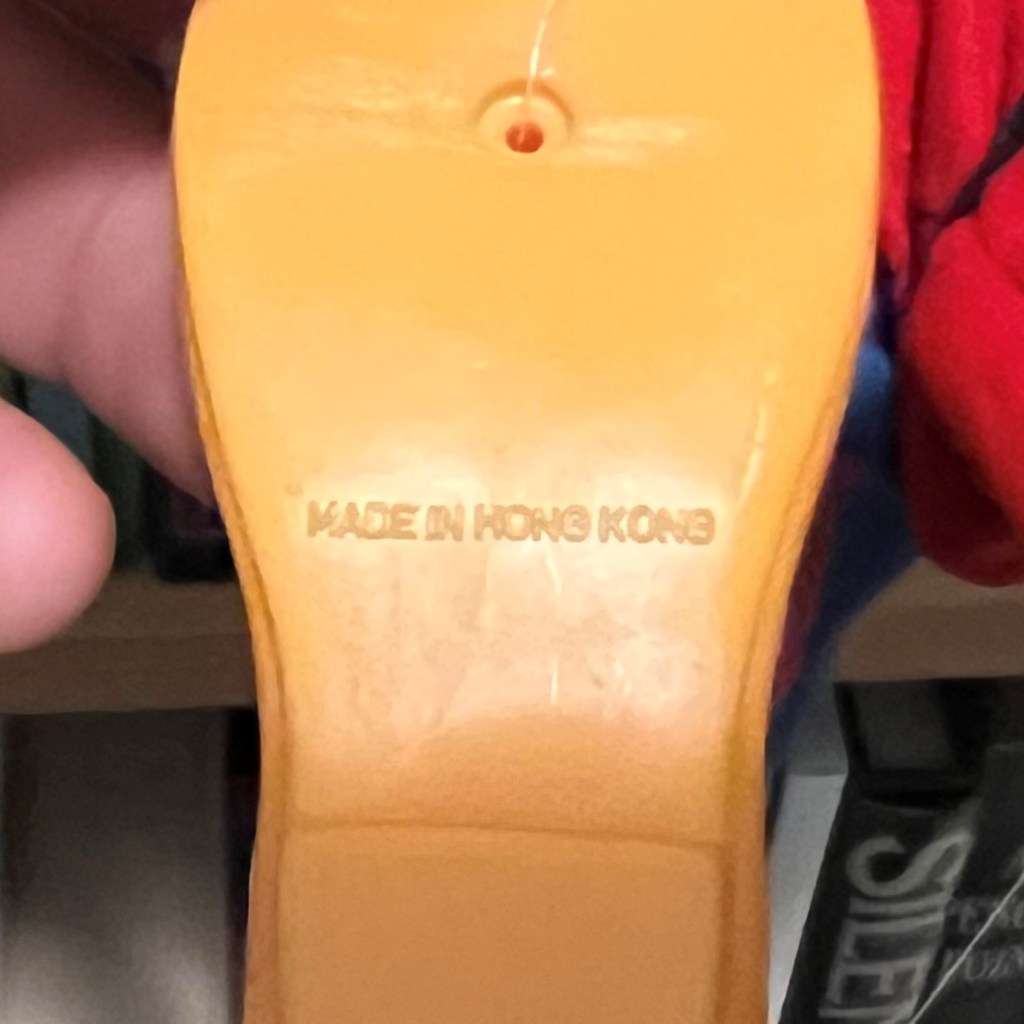
The back of Goofy’s head tells us it was commissioned by Walt Disney Productions in 1977 and the bottom of his shoes tell us that he was Made in Hong Kong.
The controller allows for three dimensions of movement. First, you can wave the arms and hands side to side. Second, you can (attempt) to make him walk by lifting his feet as you sway the puppet around. And lastly, you can raise his rump and make him jump by pulling a string at the back. The feet and hands levers are marked.
And there you have it. The Goofy marionette that will make you look goofy if you try to use it!
It’s time for another wonderfully awful compilation of music, jokes, and songs designed for the very young or those who are easily entertained.
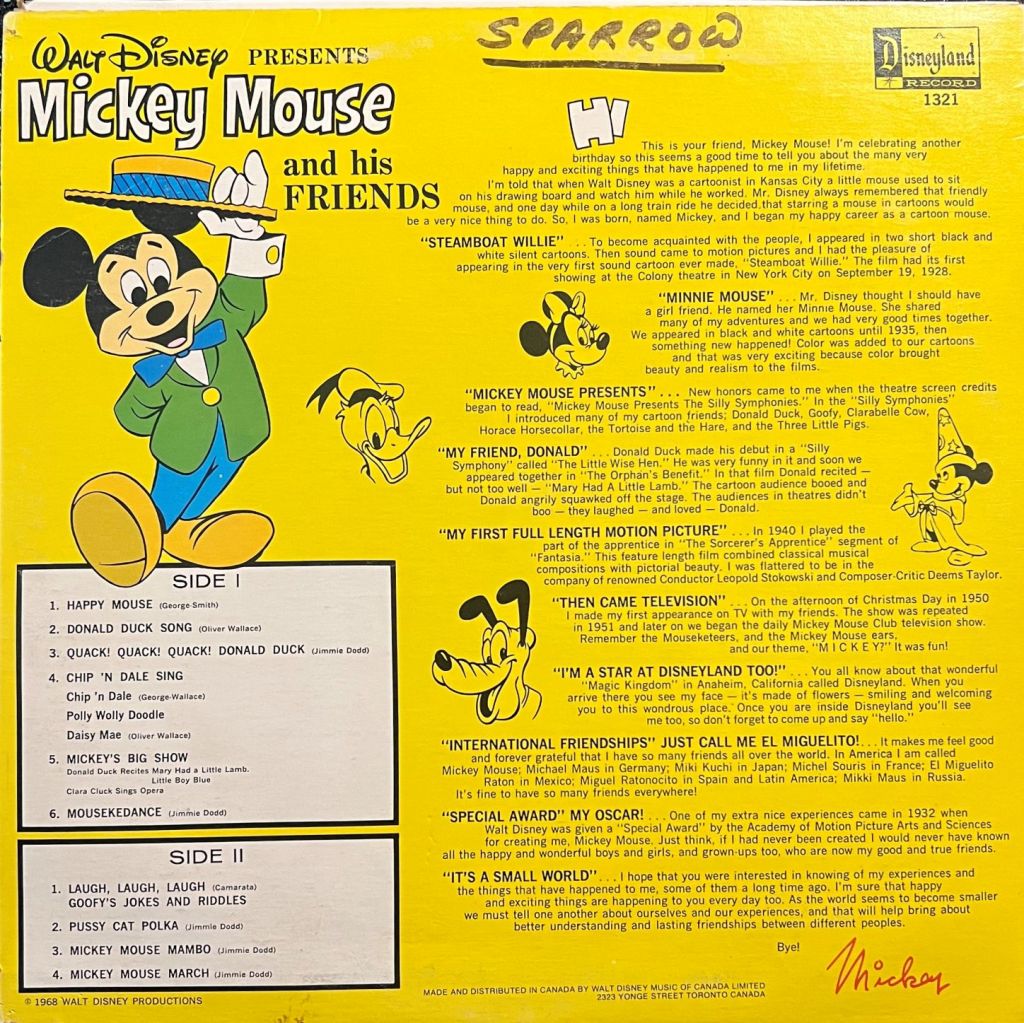
Behold in all its glory the Mickey Mouse and His Friends LP record:
Released in 1968, this LP contains a mish mash of assorted tracks taken from older albums or, in some cases, reworked versions of older songs.
Side 1
We start with the Happy Mouse song, perhaps voiced by Walt Disney himself. For more on that, please check out Goofy’s TV Spectacular LP and listen for yourself. You can also hear a reworked version of the Laugh Laugh Laugh piece found on Side 2 of this album.
Back to Side 1, we next have the Donald Duck Song, which is quite famous. Next is this little number:
Quack! Quack! Quack! Donald Duck
The middle of the side is filled with compilation music featuring Chip and Dale and other vintage characters. These tracks feature material from old Shorts. The side ends with:
Mousekedance
Side 2
We start with the aforementioned Goofy gags bit before moving on to this fun song written and performed by the adult leader of the Mickey Mouse Club, Jimmie Dodd:
Pussy Cat Polka
Side 2 concludes with two versions of the Mickey Mouse March, one with a Latin flare. The music on this LP is fun, but it will mainly appeal to 3 to 5 year olds. No sophisticated material here!
Why I mainly buy these albums, apart from the weird musical content, is for the artwork and liner notes. This album was released to commemorate the creation of Mickey Mouse in 1928. So, he would be 40 years old at the time of release. Mickey himself gives an overall look at his life and times from the fictious story about his inspiration to his international fame.
Some standout features from the text are a list of his names from around the World. And he concludes with a nice message about harmony.
Yes, Disneyland Records threw together another dilly of an album with this piece of black vinyl!





























 Disleelandia